I've been on something of a Whoniverse overdose the past two days. SciFi aired a marathon of the best of Doctor Who season 3 on Monday ("Human Nature"/"Family of Blood", one of my favorite things ever produced for television, plus "Blink" and "Utopia"/"The Sound of Drums"/"Last of the Time Lords", "The Sound of Drums" being my personal choice for most purely entertaining piece of television ever), and this combined with the glowing reviews of Torchwood's limited season three/miniseries event thing "Children of Earth" got me to watch that, too--and, before I did, the final three episodes of Torchwood's season two, which have been sitting unwatched on my computer since they aired over a year ago due to my growing indifference to the series. (A short review: the last three episodes were better but still mostly Torchwood as usual. "Children of Earth", on the other hand, is really quite good and absolutely brilliant in a few unexpected places.)

But what I'm more interested in is the political circumstances depicted in the Doctor Who finale and in "Children of Earth". I realize I'm way late to the game in analyzing the Master's return, but as a student my work is mostly analyzing old things anyway, so whatever. What's interesting to me about the political circumstances is that they aren't unusual, or different, or new, beyond the superficialities of aliens and advanced technology.

The Master (John Simm) in Doctor Who (2007)

In "The Sound of Drums", the Doctor figures out that the Master has elected himself Prime Minister of Great Britain via embedding a psychic signal within a satellite network that controls cell phones: it's not exactly mind control, the Doctor says, just an implanted rhythm (the chilling "Sound of Drums" that also reverberates uncontrollably within the Master's mind) that contains the message: "Believe in me. Vote for me." It seems like just a science fiction plot device, but the moment when the Doctor's companion's acknowledge that even they were planning on voting for the Master (before they knew who he was) resonates uncomfortably with the modern political space:
Martha: I was gonna vote for him.
The Doctor: Really?
Martha: Well, it was before I even met you. And I liked him.
Jack: Me too.
The Doctor: Why do you say that? What was his policy, what did he stand for?
Martha: I don't know, he always sounded . . . good. Like you could trust him. Just nice. He spoke about . . . I can't really remember, but it was good. Just the sound of his voice . . .
On one level it's a merely a demonstration that the Master can affect even those who should be most resistant to his machinations. But of course on another level there's a sense that this isn't actually unusual. Martha's inability to articulate the Master's policy despite her confidence in him--her admission that she simply "trust[ed] him" based on "the sound of his voice" would not sound out of place in a modern news segment interviewing voters (or more likely, a Daily Show parody ridiculing the ignorance of voters, though the difference between the comedic farce of The Daily Show and the blatant lies of mainstream news is a thin one indeed).

Ultimately this element of political commentary is dropped in favor of Doctor Who's more usual intensely absurd character drama (which I love, no mistake), but I wish there was more of it. The political aspects of the new series--Harriet Jones, UNIT, and of course Torchwood--are some of its most interesting (at least in terms of its Earth-based stories) because they do often seem to be simply our modern circumstances with aliens thrown in.

Torchwood, indeed, deals with this a bit more often (though sometimes it dodges it when I feel it shouldn't), especially in "Children of Earth". But even in its full seasons there's an interesting arc in the background of the acknowledgement of the existence of aliens by the general populace despite governments' continued official denials. For some time I considered it simply absurd and contrived that the populace at large hadn't already simply accepted this after the events of Doctor Who's seasons--the Master himself points out a number of such incidents, including the highly visible destruction of Big Ben by an alien spacecraft, as part of a press conference announcing his (as Prime Minister) official first contact with aliens (an elaborate ruse ending with his global domination, though the aliens are real).

It seems ridiculous that after this public declaration and subsequent fallout (the deaths of the Master as Prime Minister and the American President in "Last of the Time Lords") the world's governments would refuse to acknowledge aliens and that the public would, by and large, accept this. And it should be ridiculous. But the more I thought about it, the more it occured to me that such obvious, blatant lies have always been the province of government, and though in the age of decentralized social media these lies are more visible than ever before to those looking for them, they still have ridiculous powers of persistence.

Abu Ghraib

The United States' torture of detainees, its general execution of the War on Terror and the predatory nature of Western foreign policy in general, plus many, many others: they're a sort of step beyond "open secrets", those things like Israel's nuclear armaments that are officially denied but nonetheless widely acknowledged. They're things that anybody looking to know can know, that all the information about is out there and ridiculously easy to find, but that the vast majority of the public do not know, because the mainstream news refuses to acknowledge them and because the public in general simply do not want to know.

And with this depressing realization I accepted that Torchwood's treatment of the subject is actually probably accurate. Even after so many public images, most people wouldn't accept the existence of aliens--but it wouldn't be hard for them to accept it once forced to, as happens numerous times throughout Torchwood. It seems at first wierd that people accept so easily extraterrestrial life, perhaps just a necessary plot contrivance to keep 42-minute episodes moving, but once we see that they already know, in some sense, and just haven't accepted it yet, it becomes much more understandable (and, perhaps, frightening).

I've got more to say about politics and "Children of Earth", but it's of a more different sort, and so will be another post.

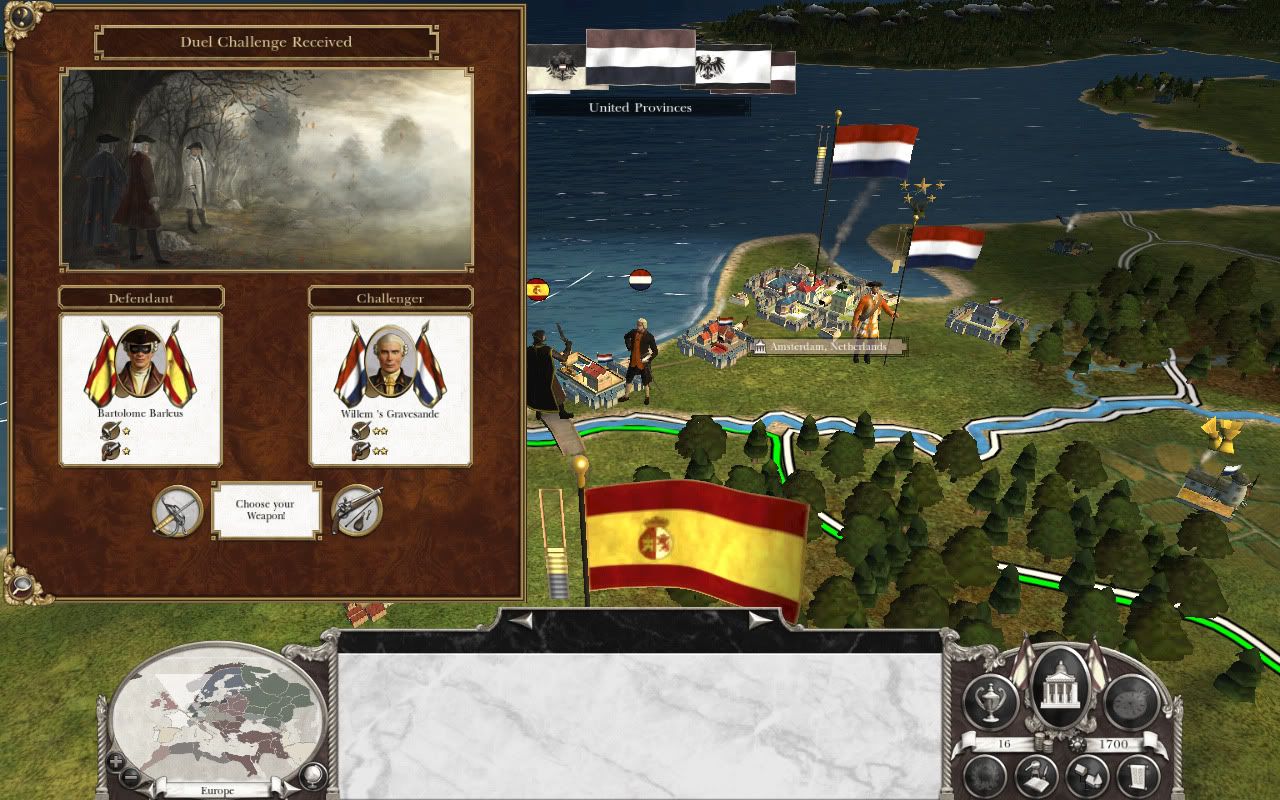
Before I can collect my tax income and proceed with restoring Spanish glory in the winter, the United Provinces offer me a chance to try out a duel. Apparently they're rather offended by that whole attempted espionage business and they send a gentleman to deal with this affront to their honor by challenging my rake to a duel. There's no option to flee, unfortunately, despite his supposed stealth skills, just a choice of weapon. I'm helpfully informed that the Dutch gentleman is better with both swords and pistols. I decide to go with swords, since that at least sounds less lethal.

Duel

I'm treated to a fancy video (seems a bit anachronistic, really) of the duel, which involves the two men chasing each other back and forth off the screen. Apparently they didn't have mobile cameras, at least. The last shot is of the gentleman running away with my rake waving his sword defiantly, and then a video of a carriage moving down a city street. I have no idea what the carriage was about since the duel took place in a wooded area, but against the odds my rake has won! That ought to show the Dutch. Maybe he'll be more confident in his sneaking next time.

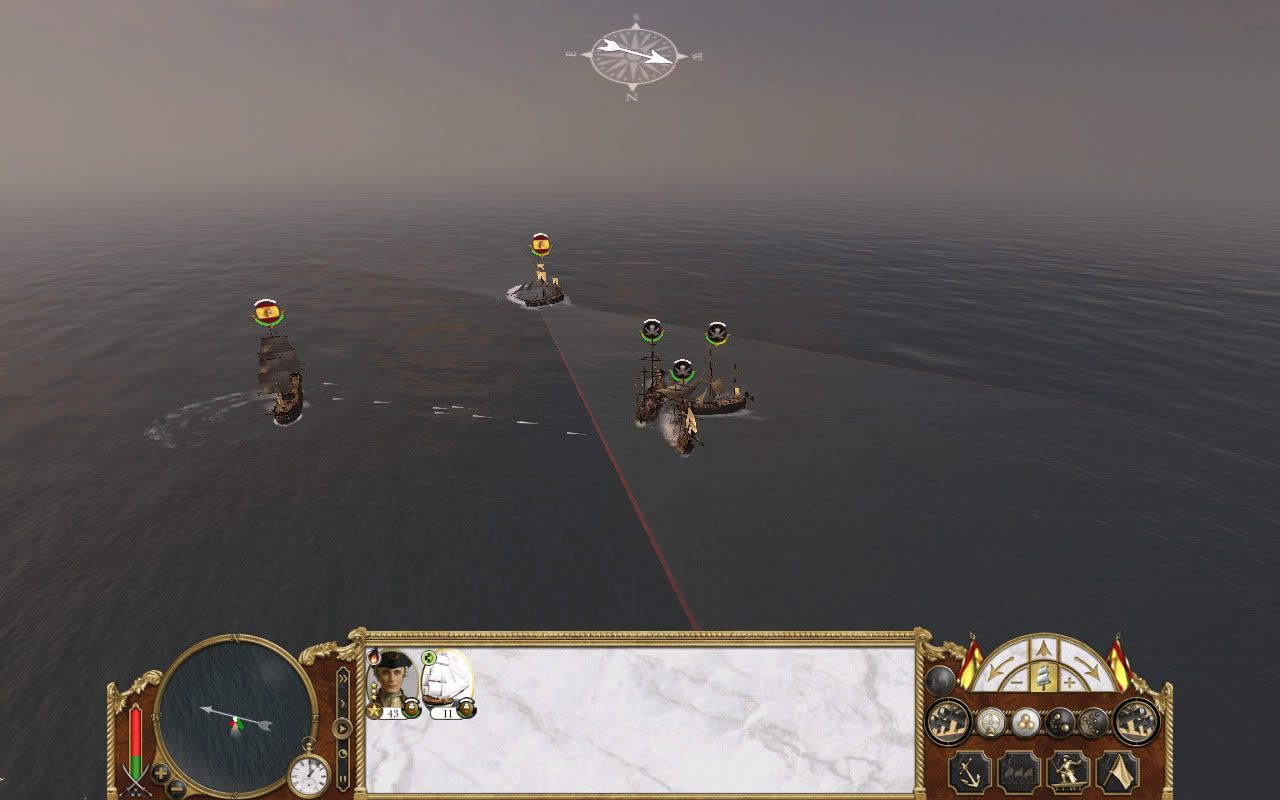
Before I can celebrate too much, however, there's another problem. Pirates have attacked by fleet in the Caribbean. And by fleet, I mean an admiral's flagship and one other ship, which is a bit less than I was expecting, but I suppose the Spanish Armada is in the past and Barbossa was an admiral with just two ships, right? This pirate's got more ships than I do, but no admiral, so I figure I've got a fighting chance and decide to duke it out. Not that fleeing from pirates was ever an option anyway, Spanish honor and all that.

Duel

It turns out the pirates may only have one more ship than me, but they have a lot more guns. For a while it looks like I might actually triumph, as I get the pirates grouped up and disable one of their ships, but things quickly fall apart after that minor victory, and soon both Spanish ships are fleeing from the battlefield. Err, battlesea? Anyway. Cowards. Shouldn't the British and French and Dutch be dealing with these guys? Or maybe New Spain?

Ah, yes. As winter rolls around, my adviser informs me that the government will occasionally assign me optional missions. Not sure who's assigning them, given that I seem to have control over everything, but in this case it's a moot point, as the mission is from New Spain. It seems a bit audacious for my own protectorate to be giving me orders. They want me to capture three territories (Texas, Curacao, and Trinidad) in exchange for giving up control to me. Shouldn't I already have control of them? This seems fishy, but they also have a lot of territory and I assume thus a lot of money. I guess it's something to work towards.

Next time: New allies, more pirates, and WAR!

I have a love-hate relationship with Civilization IV. I love the mechanics, the music, the dynamics, the customizability. I hate Isabella. Every time I played a game of Civ IV, without fail, sooner or later the Spanish came knocking. Every time, Isabella was pissed that I was a different religion than her, and sooner or later, without fail, she declared war on me. And every time I tried to negotiate with her, she just stared back haughtily at me. I have never hated a video game character so much--and all she is is an animated profile picture and some obscure game logic.

Somehow I find myself playing the Spanish in Empire: Total War.

Europe

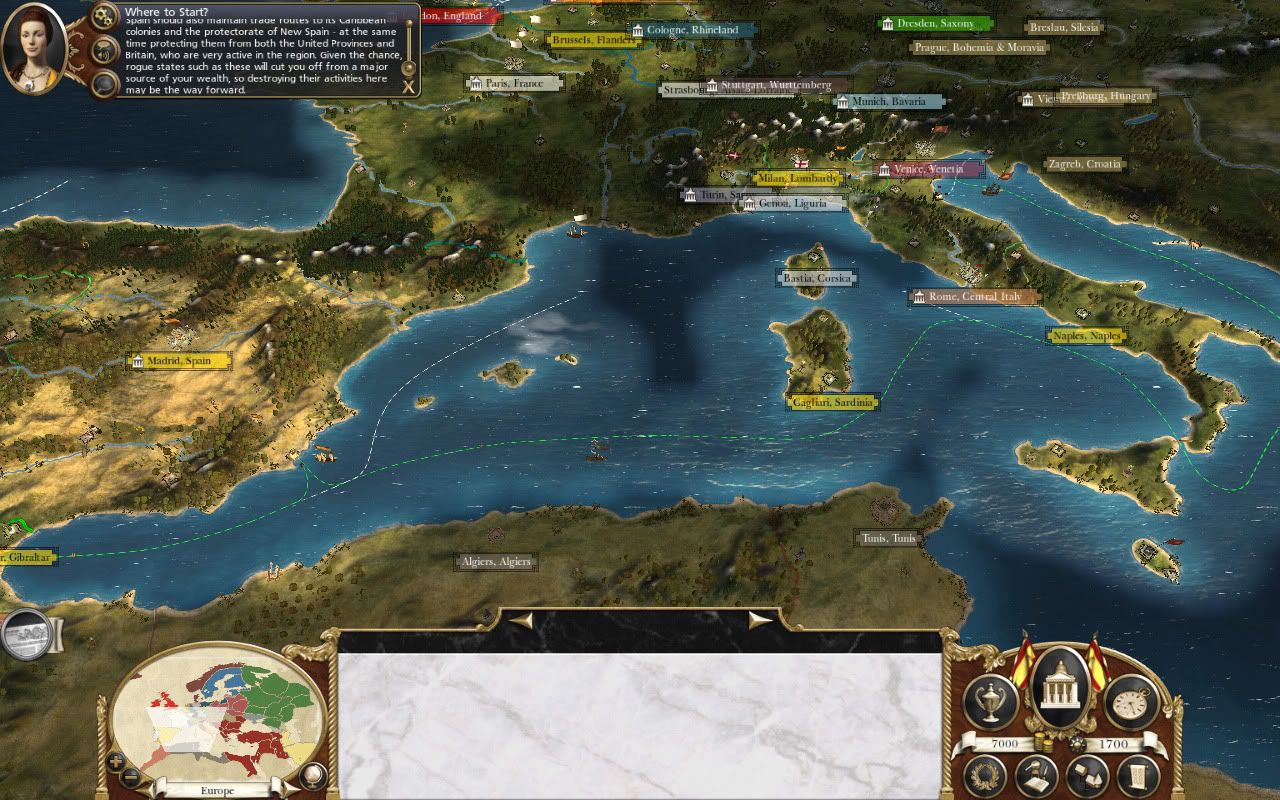
The year is 1700, and somebody's handed me control of what's left of the Spanish Empire. My history's a little hazy, but it's pretty obvious that the days of Spanish glory are in the past, though Spain does begin with control of various parts of Italy and southern Holland, which my adviser helpfully advises me is in danger of being overrun by the now Protestant republican northern Holland. She also gives me a quick overview of the Spanish possessions in the Americas, which seem surprisingly sparse until I realize that "New Spain" (all the land from California to Venezuela) is a separate faction set up as a "protectorate" but not under my direct control. Which seems a bit cheap, but they're still sending me lots of money and I'm not paying for upkeep, so I guess that works out.

America

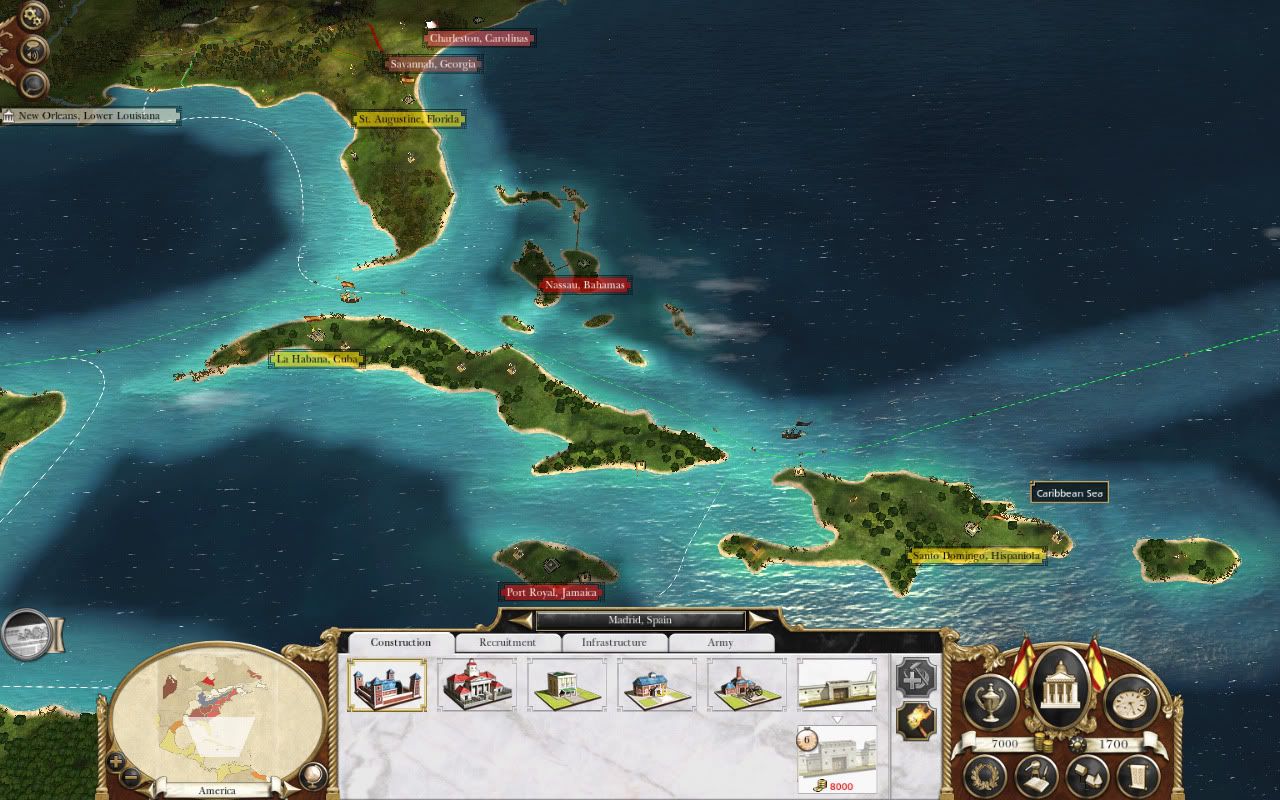
My adviser warns that the "rogue states" of Great Britain and the United Provinces (northern Holland) may attempt to take my American possessions. Apparently "rogue state" still just means "people we don't like". The adviser also warns me not to piss off the French, but they're apparently my allies, which is nice since they're right next to me and I'm not looking forward to a protracted land war right now.

Also, apparently the last lion has died in Libya. Then the game gives me control.

I start off focusing on Flanders (southern Holland), per the advice. There's a nice army stationed there already, along with my best defensive general, which is nice, but there's no walls, so I order the construction of those. There's an option to build either a governor's mansion or a military governor's encampment--I'm going with the military governor. It looks like it lets me train better units. I've also got a "rake", e.g. a spy and assassin, which I decide to sent into Rotterdam, a mission that immediately fails. Oops. The rake gets away, at least.

I decide to send a missionary to Flanders as well to convert the Protestants and maybe improve my public image after that failed spy. Unfortunately it's going to take four years for him to get there by land and there's no ships on the northern coast to get him there faster. Ah, well. Maybe I should improve roads with next year's income.


America


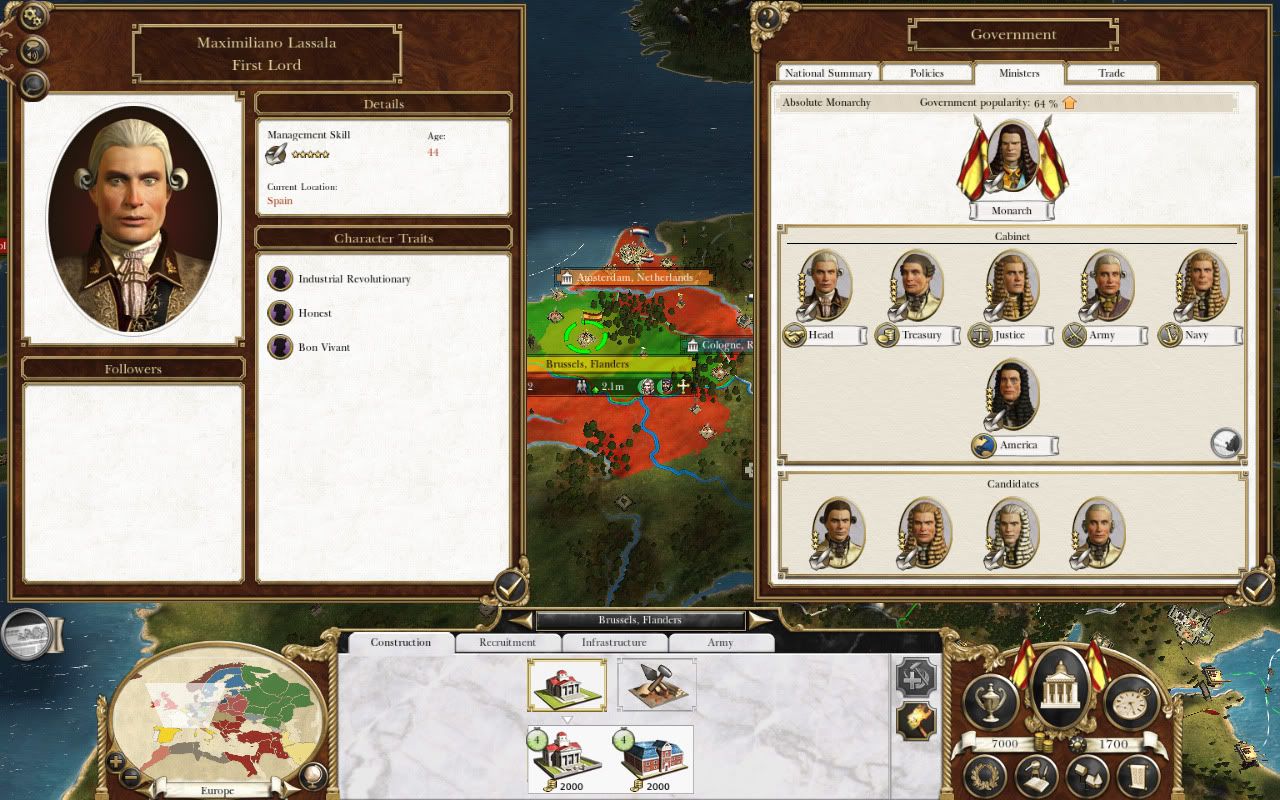
In addition to the regional options there's a lot of options for the central government, the most interesting of which are my ministers. My starting cabinet is full of floozies--apparently whoever was in charge before me didn't put much value in efficiency--but a few of the candidates are more impressive and some of the standing ministers perform better in other posts, so after some shuffling the government's looking much better. I'm hoping there are more monocled candidates soon, though.

The other significant option is technology research. There are options under military, agricultural, and more theoretical stuff. Initially I'm rather interested in the military technologies, of course, but after looking over them "Social Contract", surprisingly, grabs my eye, mainly because it increases technology research rate, which seems a good thing to get out of the way in the beginning. I also order one of my government-employed gentleman to a nearby college to speed up the research. The adviser informs me gentleman can also duel other characters, which seems too amusing not to try at some point.

Next time: pirates, a duel, and New Spain's impositions.

  • A movie about the end of the world that's not about saving the world but about who gets to live through it. Inspired by the 2012 trailers, which actually have a few interesting bits among the Roland Emmerich Epic Explosions, involving scenes of the government preparing what amounts to a modern Noah's Ark and deciding who gets on and who gets left behind. (Think also Battlestar's "Razor": "So you're going to decide just like that who lives and who dies?") You could even have lots of explosions and action shit with people revolting, trying to smuggle/attack their way onto the ark, etc., as well as a genuine Ethical Dilemma and angsty character drama (survivor's guilt, etc.).

  • A prose story (novel, novella, hypertext, whatever) about digital ghosts formed by the vast quantities of personal data left behind on the Internet in the modern world. Inspired by Caprica's pilot, except not with a stupid perfect copy but a fragmented, obviously artificial but still bearing significant resemblance construct, like a person with Alzheimer's, where sometimes they sound just like themselves and sometimes they're so very obviously not. Targeted straight at Uncanny Valley technological anxiety, identity theft fears, dreams of technological immortality via singularity and sci-fi's brains on disc trope, and more generally the piecemeal, constructed nature of modern cognizance (which has always been true obviously, just not so obvious, and the tearing away of the illusion of truth is what's so damaging and scary to us).

  • A video game about the exploration and terraforming of a new planet after Earth's downfall. Player character as the lone awakened human aboard an ark spaceship stocked with humans in hibernation/cryostasis/whatever and plant and animal specimens, sent down to a living planet's surface to scout. Encounters completely alien fauna and flora and early on involves lots of exploration porn, sweet vistas and crazy creatures and stuff, structured by a categorization mechanic ala Beyond Good and Evil or Pokemon Snap. Switches between on the planet (huge open world nonlinear exploration, with scout vehicle for fast travel around, all natural and curvy and colorful and alive) and the ark ship (cramped corridors, bulky square technological drab dead), getting orders from an AI terraforming protocol, gradually transitioning from exploration and cataloguing to terraforming, bringing in algae and small stuff at first and slowly escalating to higher terrestrial life forms, in the process wiping out the existing ecosystem. Watch all the cool creatures you hopefully became friendly with early on slowly killed off by your own efforts. Rebellion is inadvisable as the AI controls your fuel, food, water, etc. rations--and even if you just kill yourself, the AI awakens someone else to take over, and the game continues.

These are not the monsters exactly as I ran them; rather, they are updated versions based on my own experience with running them. They in general run on the more damaging side (as my players noticed) but also ideally of lower health and defenses, to get as close to L4D's greater swinginess (to use an RPG term) while still feeling like 4E. House rules that already do this (e.g. decreasing monster hit points and increasing their damage) will amplify this effect.

Zombie Horde Level 3 Brute
Huge Natural Humanoid (undead, swarm) XP 150
Initiative +1 Senses Perception +1; darkvision
Grabbing Mass aura 1; at the start its turn the zombie horde makes a melee basic attack against each enemy in the aura as a free action.
HP 55; Bloodied 27
AC 15; Fortitude 18, Reflex 15, Will 15
Immune disease, poison; Resist half damage from melee and ranged attacks, 10 necrotic; Vulnerable 5 close and area attacks, 5 radiant, 5 fire
Saving Throws +5 to effects imposed by ranged or melee attacks
Speed 6 squares, climb 4
M Slam (Standard; at-will)
Melee 1; +6 vs. AC; 2d6 + 3 damage.
m Grab (Standard; at-will)
Melee 1; +4 vs. Reflex; 1d10 + 3 damage, and the target is grabbed (until escape). Attempts to escape the zombie horde's grab take a -5 penalty.
m Engulf (against a grabbed target, standard; at-will)
Melee 1; +4 vs Fortitude; 2d6 + 3 damage, and the target is engulfed by the zombie horde (until escape). While engulfed the target is grabbed, restrained, takes ongoing 10 damage (ongoing 5 while the zombie horde is bloodied), and slides into an adjacent square occupied by the zombie horde. An attempt to escape being engulfed takes a -5 penalty (not cumulative with the zombie horde's Grab penalty). Any ranged or melee attack against the target instead targets the zombie horde. While engulfing a target, the zombie horde can take no action other than to sustain the engulfment, although its aura still functions.
Horde Stability
The zombie horde can reduce any push, pull, or slide effect against it by 1 square.
Thinning Out (when first bloodied)
The zombie horde's size changes to Large, and all its attacks take a -2 penalty to damage.
Stragglers (when reduced to 0 hit points)
Three zombie rotters appear in any unoccupied space formerly occupied by the zombie horde.
Alignment Unaligned Languages --
Str 16 (+4) Dex 11 (+1) Wis 11 (+1)
Con 15 (+3) Int 3 (-3) Cha 3 (-3)

The zombie horde owes much of its design to a similar homebrew monster on the EN World forums by a user whose name I unfortunately do not recall. It begins as a fairly normal swarm creature (though unusual in that it is a swarm of Medium creatures) with an unusual and powerful Engulf ability that unfortunately I never got to try out in actual combat. The Engulf ability is meant to simulate getting surrounded by the horde in L4D and is quite dangerous, although as a brute the attack is unlikely to hit.

One of the additions to most of these monsters from the versions I ran is a vulnerability to fire. When the tank attacked my players their first thought was to set it on fire; I had not originally included any rules for it, but I decided on the fly to give the tank vulnerability to fire (although not actually catch on fire from such damage, to my players' disappointment), which I then transferred over to the rest of the zombies as I went over them afterwards. Purely from a 4E stand point, the radiant vulnerability is completely servicable and adding fire gives them an additional weakness, but fire is such an iconic part of L4D that I didn't want to give it up.

Zombie Hunter Level 3 Lurker
Medium Natural Humanoid (undead) XP 150
Initiative +8 Senses Perception +8; darkvision
HP 37; Bloodied 18
AC 17; Fortitude 16, Reflex 18, Will 16
Immune disease, poison; Resist 10 necrotic; Vulnerable 5 radiant, 5 fire
Speed 8 squares, climb 6 (spider climb)
M Claw (Standard; at-will)
Melee 1; +8 vs. AC; 2d6 + 3 damage.
m Pounce (only usable as part of a charge; standard; at-will)
Melee 1; +6 vs. Reflex; 1d6 + 3 damage, ongoing 5 damage, and the target is grabbed and dazed (escape ends all) and knocked prone. Attempts to escape the zombie hunter's grab take a -5 penalty. The zombie hunter enters the target's space, is dazed, and any melee or ranged attack against the target instead targets the zombie hunter. If the zombie hunter leaves the target's space for any reason, the grab ends.
Leaper
As a move action or as part of a charge, the zombie hunter can jump up to its speed without making an Athletics check and gains a +4 bonus to defenses against opportunity attacks provoked by jumping.
Flaming Hunter
If the zombie hunter takes fire damage, its attacks on its next turn gain a +2 bonus to damage (including ongoing damage).
Alignment Unaligned Languages --
Skills Stealth +9, Acrobatics +9
Str 14 (+3) Dex 17 (+4) Wis 14 (+3)
Con 13 (+2) Int 4 (-2) Cha 3 (-3)

Hunters were especially interesting to design due to their Pounce attack. I borrowed from the horde's already established Engulf ability for an attack that did a lot of damage if sustained (though, like the actual L4D hunter, the initial damage is less than a simple claw swipe) but also made the hunter more vulnerable. (In one encounter, I had a horde attack a hunter pounced on a character due to its aura; I figured it fit the mindlessness of the Horde.)

Flaming Hunter is one of my favorite features of any monster I've ever designed. Part of it is that I like the idea of mixing advantages and dangers--hit the hunter with fire to do more damage to it, but also make it do more damage. And part of it is simply for the fact that flaming hunters are probably my favorite part of L4D, to the point that I giddily scream "Flaming hunter!" and intentionally set myself on fire when playing as one. (I suppose a few people might not actually know: hunters in L4D do significantly more damage when on fire. They also don't take ongoing damage from fire while pouncing someone, which makes setting yourself on fire extremely effective in most situations.)

Zombie Smoker Level 3 Controller
Medium Natural Humanoid (undead) XP 150
Initiative +4 Senses Perception +3; darkvision
HP 43; Bloodied 21
AC 17; Fortitude 16, Reflex 17, Will 16
Immune disease, poison; Resist 10 necrotic; Vulnerable 5 radiant, 5 fire
Speed 6 squares, climb 5
M Claw (Standard; at-will)
Melee 1; +8 vs AC; 1d6 + 3 damage.
r Tongue Grab (Standard; recharge 56)
Ranged 10; +7 vs Reflex; 2d6 + 3 damage, ongoing 5 (until escape, and the target is knocked prone, pulled 3, and grabbed (until escape). Attempts to escape the zombie smoker's grab take a -5 penalty.
Sustain Standard: the target is pulled 3 squares. The first time the zombie smoker sustains this power, the target is dazed (until escape). The second time the zombie smoker sustains this power, the target becomes unconscious (until the target takes damage from an attack). If the zombie smoker fails to sustain this power, the target automatically escapes at the end of the zombie smoker's turn. The zombie smoker can only recharge this power when it does not have a target grabbed.
c Smoking Cloud (when the zombie smoker is reduced to 0 hit points) ♦ poison
Close burst 1; +7 vs Fortitude; 1d6 + 3 poison damage, and the target is weakened and takes a -2 penalty to attack rolls until the end of its next turn.
Alignment Unaligned Languages --
Skills Stealth +9
Str 14 (+3) Dex 17 (+4) Wis 14 (+3)
Con 11 (+1) Int 5 (-2) Cha 3 (-3)

The smoker is my favorite of L4D's zombies, and it proved the most annoying of any of the zombies in the 4E version due to its ability to attack at range and quickly disappear. The smoker is labeled here as a Controller, but that's mostly for diversity: all of the specials are clearly Lurkers, with the boomer having an obvious Leader ability as well, but smokers clearly have a minor in controlling as well--their job, after all, is not so much damage as disruption of the survivors' formation.

While the smoker proved the most annoying of foes for my players, it never managed to sustain its grab long enough to reach the more powerful effects (it kept strangling the ranger, who had a very high Acrobatics modifier), so I'm not sure how those work out. Obviously it's very powerful for a level 3 monster, but I also ruled that players could use their own move action to make an escape check for the grabbed player (essentially L4D's melee-to-free), which I don't think is RAW an option but seems reasonable.

Zombie Boomer Level 2 Lurker (Leader)
Medium Natural Humanoid (undead) XP 125
Initiative +5 Senses Perception +1; darkvision
Boomer Stench aura 1; enemies in the aura take a -2 penalty to attack rolls.
HP 26; Bloodied 13
AC 15; Fortitude 13, Reflex 13, Will 14
Immune disease, poison; Resist 10 necrotic; Vulnerable 5 radiant, 5 force
Speed 5 squares
M Claw (Standard; at-will)
Melee 1; +7 vs. AC; 1d6 + 3 damage.
c Vomit (Standard; recharge 6) ♦ Acid
Close blast 3; +5 vs Reflex; 1d10 + 3 acid damage, and the target is blinded (save ends). While a target is blinded, zombies gain a +4 bonus to damage rolls against the target.
c Boomer Burst (when the zombie boomer is reduced to 0 hit points) ♦ Acid
Close burst 2; the zombie boomer makes a Vomit attack against each non-zombie creature in range.
Alignment Unaligned Languages --
Str 13 (+2) Dex 11 (+1) Wis 11 (+1)
Con 8 (+0) Int 3 (-3) Cha 3 (-3)

Boomers are a finicky beast. Due to the way hit points work they need to be of lower level (or have a general vulnerability, I suppose, or make them minions, which would be hilarious) than the other zombies to make them seem easier to kill. I also didn't get a chance to see how their signature vomit interacted with zombies in play; the boomer's only appearance in combat only hit one player and the only other zombie around, a horde, was blocked by the rest of the characters.

Zombie Tank Level 3 Elite Brute
Large Natural Humanoid (undead) XP 300
Initiative +1 Senses Perception +2; darkvision
HP 116; Bloodied 58
Regeneration 5
AC 17; Fortitude 19, Reflex 15, Will 16
Immune disease, poison; Resist 10 necrotic; Vulnerable fire, radiant; if the zombie tank takes fire or radiant damage, its regeneration does not function on its next turn.
Saving Throws +2
Speed 7 squares, climb 4
Action Points 1
M Slam (Standard; at-will)
Melee 1; +6 vs AC; 2d6 + 3 damage, and the target is pushed 3 squares and knocked prone.
m Smash (against a prone target; sandard; at-will)
Melee 1; +6 vs AC; 3d8 + 3 damage.
a Rock Throw (Standard; recharge 3456)
Area burst 1 within 10 squares; 1d6 + 3 damage, and the target is pushed 1 square and knocked prone.
Swat (when an enemy moves adjacent to the zombie tank; immediate reaction; at-will)
The zombie tank makes a melee basic attack against the triggering enemy.
Alignment Unaligned Languages --
Skills Athletics +9
Str 17 (+4) Dex 11 (+1) Wis 13 (+2)
Con 18 (+5) Int 3 (-3) Cha 3 (-3)

Ah, the tank. The players appropriately grew terrified when the tank arrived, although due to its lack of entourage it failed to live up to expectations. And while its Slam and Swat abilities proved accurately powerful, I never got a chance to use Smash, which would have a significant chance of knocking a level-appropriate character unconscious. Due to the interior setting I also never used Rock Throw, but only pansies use that anyway. Unfortunately I could figure out no way to included the tank's ability to kill everyone with one punted log, car, or forklift and stay balanced.