Showing posts with label video games. Show all posts

Remember when I posted part one of two of an essay on Mirror's Edge? That's okay, I'm pretty sure no one else does either.

Mirror's Edge

The inclusion of a story at all in Mirror's Edge feels a bit unnecessary and problematic; especially in its execution, flabby and perfunctory, it makes the game feel like any other unimpressive video game, plot and cutscenes tacked on because they're expected but not with any real effort put into them.

Yet the idea itself, of an underground struggle against a corporate police state, fits well thematically for a game whose central inspiration is free running. It seems an appropriate marriage of plot and mechanic, of story and mechanic, in the traditional sense of those terms, both using the theme of freedom and oppression.


Freedom Fighters

It's a tall order, though, to make a game about freedom. Plenty of games have had a "fight for freedom" as their plot--any World War II game, usually; Freedom Fighters, of course; and so many others--but most of the time the plot is, again, perfunctory, an afterthought, and therefore no one expects any actual connection between that plot theme and the gameplay. In Mirror's Edge, though, the connection is much more explicit. A promise is, in some way, being made: as much as this is a game about flow, it is a game about freedom. And, as much as it fails to actually flow, and for much of the same reasons, the game fails to actually be free.

On the large-scale structural level, the game's linear and fixed series of levels, coupled with linear and fixed plot advancement, clearly doesn't even have a pretense of player freedom. On that level the game is a movie, just like so many other games: there are characters, they talk to each other in shitty movie dialogue, they fight or run or die, and players get to watch, without any choice or influence.

But this could be forgiven despite the game's promise of freedom if the game offered freedom on a smaller scale, the scale of the gamespace of the levels and the mechanics themselves--that's the more important part of the game, obviously, and what has much more impact on the thematic effect of a game. But of course there isn't any more freedom on this level, either: most sequences have one or at most two or three paths through them, with one branch or another offering little to no impact on future gameplay, and in the constant adrenaline rush pace of the game you don't have the opportunity to think much about your options anyway.

Grand Theft Auto 3

The obvious contrary here is to open world games like Grand Theft Auto or, well, pretty much any game from the past two years, as open world is currently quite in vogue. Mirror's Edge would actually make sense as an open world game, though, giving players something closer to the actual experience of free running, which is as much about breaking social norms, experimentation, and finding new ways to move as it is about looking cool. Mirror's Edge allows the player to do none of these, in fact enforces the opposite of this: you must follow the rigid, strict path set by the developers, or you fail. Experimentation is punished, not rewarded. You are not free.

But even if Mirror's Edge had been an open world game, wandering around the rooftops of the city Crashdown-style and taking conflicting missions from various characters, there would still be the mechanics themselves, conventional--nowadays perhaps even better referred to as old-school--platformer mechanics that are brutally strict, with very little valence between "successful jump" and "death". Higher jumps, true, have a further dimension of whether you successfully roll with the landing, thereby avoiding damage and keeping your momentum, or simply hit the ground hard, leaving yourself limping; but this is still just another aspect of "right" or "wrong", "succeed" or "fail", binaries of morality/efficiency that are antithetical to any discourse of freedom.

If Mirror's Edge, or any game, wants to truly be about freedom, its base mechanics need to reflect that, and that means more results than simply variances on a scale of positive to negative. That means that even the solutions of its platforming near-contemporaries--time reversal, quickload, etc.--would be just as ineffective: they might be more forgiving of mistakes, but they still enforce a strict difference between mistakes and the "right way" to play the game.

Sim City 3000

What's needed, really, are mechanics in which the different results of player choices are not merely "better" or "worse" ways of playing, not mechanics that can be optimized to achieve the most efficient completion. I'm not talking the "morality scale" endemic to (Western) RPGs, either, as that's just another binary system that confines players to developer expectations. Rather I'm talking about something like Sim City, something that's more toy than game, where rather than a structured game with set goals and win conditions the player is presented with a model of a world and a set of ways to interact with that model and then set loose to do what they will.

You can still have "better" and "worse" choices within particular subsystems--that is, you can still have ways that make your city poor or rich, or jumps that lead to your death--but the point is that navigating those subsystems is not the core of the game. They are important, sure, but only in that you have to understand how to navigate those systems in order to achieve your own goals, decided by yourself, and that those goals determine what systems you need to understand, and how you need to use them.

I realize that this sounds very, very far from the conception of Mirror's Edge. And in some ways it is--but not in the important ways, I think. This could still be a game based on free running--and now it would be a game that is actually about free running, about freedom and experimentation and defying expectations and making your own discoveries, rather than just another linear platformer with an unfulfilled promise of something better.

This afternoon, after some tedious work getting all the updates working, I finally started playing my recently purchased copy of The Witcher, an eastern European RPG from 2007 based on a Polish series of fantasy novels. I've just completed the prologue/tutorial so far, but I'd like to share a story.

After a lengthy opening pre-rendered cutscene (which unfortunately didn't have any sound due to a bug, I assume), the game opens with . . . a very long in-engine cutscene, beginning with the protagonist, Geralt, being carred unconscious on a wagon back to the mountain fortress of the witchers, an infamous group of mutants who hunt monsters, according to the game's omniscient narration. All swell, until Geralt opens his mouth: "I don't remember anything."

Well, if there's anything to create a negative first impression, especially in an RPG, it's amnesia. I know of two games that dealt with it well (Torment, where the basic mystery of it is done away with fairly quickly, and Sanitarium, where it's the entire point of the game), and already it feels tacked on considering that the game has made very clear who the main character is--Geralt of Riveria, the White Wolf, one of the most famous of the surviving witchers.

I realize soon enough that the device is a necessary evil for the game to equally behave as a traditional RPG and allow the player to control Geralt. Amnesia allows the game to introduce the narrative and mechanical aspects of the world as if they were new to the character as well as the player, which is of course the usual reason for its inclusion in RPGs, and also to have the player start with a first-level character, as opposed to the great monster slayer that Geralt is already. (Which seems a bit disingenuous to me. What's the point of playing a famous hero if you don't start super powerful?)

Anyway, the cutscene finally (and I do mean finally, it is damned long) gives way to the combat tutorial as a band of hilariously incompetent bandits attack the castle. But as the prologue goes on, involving Geralt, his sorceress girlfriend Triss, and four other witchers (well, three witchers and a trainee) defending the castle against what they discover is a much more calculated and dangerous incursion, a number of strange things begin to strike my mind.

The first is as I'm sent to sound some bells in a high tower to damage a giant monster vulnerable to loud noises. In a cutscene (arg!), the stairs, which circle a bit that falls to open ground rather than a stone floor, begin collapsing. Geralt gets to the top but the bandits pursuing him are left behind as I watch agape and wonder, how does an inhabited castle have collapsing stairs? The next time Geralt meets up with the other witchers their leader apologizes and comments that one of the others was supposed to fix it, to which the witcher in question McCoys that he's not a mason.

For the rest of the sequence I'm too concerned with stopping a powerful sorcerer, regaining some magic powers, and getting upset over the trainee's death at the hands of an assassin awesomely called "The Professor" to notice other odd things, but once combat is over and I'm sent to collect the ingredients for a healing potion for Triss, things get stranger. As the witcher leader warns me that there are still some stragglers about the castle--bandits they didn't kill--I begin to question the narrative integrity of this game.

Would they really let any of the bandits get away? It seems ridiculous except as a device to provide more combat during this fetch quest. And where are the rest of the witchers, anyway? The opening cutscene showed a huge castle, yet all I've seen are five other people here. Shouldn't the rest of the castle been helping to defend against the attack? That would have made it too easy, of course. And would there really be no significant defenses against an incursion into the witchers' most secret sanctuary, the laboratory they never allowed even Triss to enter?

As I explore the castle, I'm confused by its appearance more as a ruin than an active fortress. There are huge cracks in the walls, more collapsed staircases, a flooded basement, and many rooms that are either empty or hold only a few random pieces of junk--a dusty, broken chest, a twisted metal bedframe. Beyond the central area the witchers stay in with the wounded Triss and a few select rooms--a library, Triss' bedroom at the top of a tower--the castle is an abandoned relic.

I begin to question my cynical analysis of the game, and slowly I realize the story behind all of this. The four witchers and Triss are the only people left in the fortress, they alone maintaining a glimmer of whatever former glory the witchers might have once possessed. And they're not enough to maintain a massive castle, of course, and so they maintain a few areas they use and leave the rest to rot. The bell tower was seldom used, and the witchers aren't masons, and so the stairs had never been repaired. The stragglers were left to roam the castle because the witchers didn't have enough men to confidently root them out and still defend their central living area. The laboratory was undefended because everyone in the castle was already fighting.

At first I'm not sure if this is the truth or just me coming up with an explanation that gives the game more credit than it's worth, but when I return with the potion ingredients and speak to the witcher leader, one of the optional dialogues leads to him telling the story of an attack on the castle some twenty years earlier, in which the then twenty-four witchers and several dozen trainees were all murdered, save for himself, who survived by hiding among the corpses. (I assume he simply fails to mention the numerous servants that must have kept the castle running, but in fariness, he probably wouldn't mention them, being beneath the consideration of such a powerful man.)

There's another fact that emerges from this dialogue, too: there will be no more witchers. While the laboratory contained the tools necessary for the brutal process of chemical and magical mutation that produces them (which is itself an interestingly scientific position in a fantasy setting), they didn't have a mage powerful enough to perform the necessary rituals, and it's unclear whether the witcher leader even knew said rituals, himself being quite young when the rest of the order was slaughtered.

And thus my respect for the game shoots up immensely. Perhaps they could have done a better job introducing the status of the witchers and their castle, but once it becomes clear, the story is tragic and touching. And it lends a fatalistic quality to (at least the start of) the game's main quest, which is to find the mysterious sorcerer who led the attack. The witchers split up for the four corners of the world in search of clues not hoping to stop some great evil or save the world but simply looking to avenge their fallen comrade and retrieve their stolen potions that are of no use to them. Even if they succeed, it's likely that more of them will perish in the quest, and they'll have gained nothing for it. But they can't gain anything anyway--they are the last of the witchers, and they know it.

Which, despite everything else, is a great way to start to game.

She tells us from the beginning: it's about flow.

Mirror's Edge

Mirror's Edge is a fascinating game in many respects. It's a first-person platformer, which is unique enough, but it's through its mechanical and narrative focus on replicating parkour/free running that the game truly shines as something new and interesting.

The problem with platformers is that they too often devolve into frustrating puzzles where players calculate and repeatedly attempt a series of jumps and other special moves, failing and iterating their technique until they find the intended solution and reach their goal. (Perhaps it's thus fitting that platformers are often referred to as "adventure games" on consoles, leading to genre confusion/ignorance.) But while true adventure games are often predicated on the satisfaction of solving a puzzle after much mental anguish, platformers are usually intended as much more visceral, continuous experiences. Games with flow.

Prince of Persia: The Sands of Time

It's the same problem that has plagued shooters and led to the introduction of health regeneration in Halo and others, and in platformers of the time rewind mechanic of The Sands of Time and the ultimate quickload in the latest Prince of Persia. And yet many of these games still have a natural rhythm of starting and stopping, still have a pace that lulls and rises. I don't know of any game that has demanded a constant pace and flow as Mirror's Edge--a game that knows nothing of the above devices.

Mirror's Edge is game so focused on the constant adrenaline rush--so focused on keeping players running that even the protagonist's title is "runner"--that players never have the opportunity to stop and contemplate their options, analyze their surroundings and figure out the best method of jumps and climbs and wall runs to get to where they're trying to go. Almost any time you stop in Mirror's Edge, the "blues" (antagonistic police) show up quickly, forcing you to keep running (or engage in the game's feeble combat system, which is both poor and out-of-place, although the guns are suitably lethal that if you are willing to use them combat is at least laughably easy).

This isn't intrinsically a bad thing. In fact it's an interesting scenario, putting players in an unfamiliar situation where they're on the run, not the bad guys. Most gamers are used to being gods compared to their enemies, who are only dangerous in mass numbers; Mirror's Edge manages to make players truly feel hunted, as if they need to run in order to survive, which is certainly an accomplishment to be applauded.

The problem is that the game's spaces don't take this into account. They're designed like most platformer spaces, with lots of red herrings and only one or a few routes to the goal. It's extremely easy to miscalculate a jump and fall to your death, and even if you make it's hard to be sure you're going the right way. And you don't have any time to think, because the blues are coming. You have to run and run, and you don't know where you're going, or what you're supposed to do. And so the game becomes simply frustrating instead of tense.

Half-Life 2

Part of the problem is the game's art direction. Its minimalism is brilliant but I can't help but wish the game's art director had learned a bit from Valve and Half-Life, the masters of subtly drawing players' attention. Throughout Mirror's Edge their are voice overs that theoretically point you towards your goal--some distant building, usually--but frequently the building blends in with its surroundings (despite the saturated and limited color scheme allowing for strong definition, as the runner's sight mechanic demonstrates), and even if you can locate it the route is usually so opaque and roundabout that sighting your eventual goal is next to worthless.

This, I assume, was the genesis of the "runner's sight", the mechanic whereby helpful ramps, bars, walls, etc. turn strongly red as the player approaches, explained as the protagonist's runner intuition. It feels like a cheat (and indeed the hardest difficulty mandates turning it off), a way to guide players because the developers' couldn't figure out a better way. It's such a blatant way of directing players, putting up a giant glowing sign saying Go Here!, that I sometimes felt offended, like I was being treated as a child. But most of the time I didn't, because most of the time I needed those clues because there weren't any others in the game. And sometimes even when I had those clues I still didn't know where to go.

But ultimately I think it's a problem of unfocused goals. It seems the developers just weren't sure what kind of game they were trying to make, how their game was that different from most platformers, and what other changes they needed to make to make those differences work. When you know where to go, Mirror's Edge approaches brilliance, the experience reaching towards the exhilaration and terror the game seems to be aiming for. But every time you screw up, the experience is ruined; and you screw up a lot.

House of the Dead

At times while I was playing it I almost wished the game was something that might be termed a rail platformer, a platforming version of arcade rail shooters like House of the Dead, whereby instead of shooting the zombies at each screen you simply jumped at the right time, or made simple choices to go left or right, etc., at various points. A node-based platformer, in which the mechanics of actually getting a jump right were left behind. Because that seemed the easiest way to actually accomplish the experience Mirror's Edge aims and fails to achieve.

But that speculation got me thinking about a much greater problem I have with Mirror's Edge, one that gnawed away at me as I played the game at a place low enough it didn't even register consciously for some time. And that's the fact that in a game about free running, it seems to forget about the free.

There's a conventional wisdom among some game developers and enthusiasts that in order for the player to have fun, the fun way has to be the easiest way. That is, players don't care about how they're "supposed" to play the game if they can find an easier way of doing it, even if that easier way is boring, dull, repetitive, etc.--and they'll then get bored with the game quickly and blame the developer for having failed at making a fun game.

And there are certainly many players for whom this wisdom holds true. Those who played Left 4 Dead by simply hiding in a corner and meleeing their way through a horde of zombies (and thus prompted the melee fatigue patch), to name a recent example.

And there is nothing wrong with such players, at least in their playing style. (Blaming the developer when they don't enjoy the game seems a bit much, though.) For many such players, they wouldn't blame the developer because they aren't looking for a game to be "fun"; or rather, fun has a different meaning to them than other players. For them, it simply means accomplishment, overcoming the challenge presented by the game by any means possible. These are the compulsive gamers, who strive for every achievement, the highest level, the fastest solution, etc. (And those that don't complain are publishers' wet dreams: they consume games with very little regard for their quality.)

But I'm more interested in the games that could be said to actively defy this play style. That is, all such players will generally end up doing things in a game unintended by the developer (which is absolutely right and good, all players should) and more importantly things that make the game arguably less interesting, but there are some games where such players will miss the entire point of the game. Which brings me to the Hitman series.

Hitman

Hitman's protagonist is a genetically-engineered super-assassin known as Forty-Seven. While fragile compared to some FPS protagonists, he's far stronger than any human or any enemy in the games: he can take a shotgun blast to the chest and keep on going. (Two, however, starts to push it, and there's no way of regaining health during a mission.) On most missions, Forty-Seven could easily get to his target by simply cutting down everyone with a gun. Enemies in Hitman are fragile: a bullet to the head is instant death, it only takes a few more shots to the chest with a pistol, and a heavy weapon buts down anyone with a single burst anywhere.

But the game's design is based around stealth. It's a game about sneaking in, knocking out a lone guard, taking his uniform, hiding his body, infiltrating a compound without rousing suspicion, silently assassinating the target, and then getting out before anyone is the wiser. It's a game in which an FPS-style massacre means you've screwed up. Yet there is little in-game penalty for such action, and it's certainly easier than the stealth approach. Unlike some stealth games--like the Thief series, where stealth is a requirement because almost any enemy will easily dispatch you in one-on-one combat, or the Splinter Cell series, where stealth is a requirement because you fail most missions if anyone "raises an alarm"--Hitman is perfectly content to allow you to complete a mission through mass murder.

Forty-Seven Massacre

from The Amateur

There are a few drawbacks--the later games rate your performance on each mission based on your stealthiness, with the highest rating offering some unlockable bonuses, and the first and fourth game, which allow you to purchase your own equipment, penalize you monetarily ("clean-up" expenses deducted from your payment). But by and large, you can ignore nearly every major mechanic of the game and simply shoot your way through if you want. The game will play like an extremely easy and short third-person shooter.

So why is Hitman one of the more well-regarded franchises on the PC, especially the fourth game, which garnered nearly universal praise? Because most players understand what's fun about the game. Because most players understand that survival is not the challenge in Hitman. Completing the mission is not the challenge in Hitman. Just because the game allows you to advance on those conditions alone, they are not victory.

Well, that's not exactly true, of course. As soon as you try to define "victory" or the "challenge" of a game as anything other than reaching the end screen, you're in subjective territory. (Not than anything is truly objective, but you get the idea, I hope.) But what we're talking about is just that--players defining their own victory conditions. Players deciding that merely advancing in the game is not good enough for them.

(As a side note, an interesting thought just occured to me that in essence, Hitman is a game that allows you to fail. Because the game is so easy in terms of simply finishing the missions, you don't see a game over screen or are otherwise forced to reload a saved game very often. Most of the time when you restart a mission or load a save, it's by your own choice--you failed your own conditions, not the game's, and you could have continued if you had wanted to. And that's a very interesting and powerful thing, to me, the option to fail and go on, though I won't be exploring it in this post.)

There are a couple things that are very interesting to me about this. The first is the meta aspect: because Forty-Seven can easily dispatch everyone in a given mission, the fact that he (canonically) doesn't and instead pursues stealthy execution means that he is, in some way, playing a game with his targets. Forty-Seven, unlike most shooter protagonists, isn't in this for survival. That's easy. He's in it for invisibility. He's in it about satisfying his own chosen conditions. He's playing a game, just like the players.

There's often a disconnect between the abilities of a player and the supposed abilities of a game's protagonist. Half-Life, for example, is often mocked for its MIT graduate lab assistant who manages to slaughter Marines and stop an alien invasion, while on the other side, many games with military protagonists are forced to treat players like ignorant civilians (like they are) rather than well-trained soldiers. Hitman, to me, is one of the few games that evades this problem. There are a few moments in cutscenes when the player may know more than Forty-Seven (he is ignorant of a lot of human culture due to his upbringing), but for the most part the story's treatment of the character matches up with players' abilities.

Gordon Freeman

The second interesting thing to me is that by making the game's conditions of advancement easy to satisfy, it encourages players to make their own rules. I started this post talking about players who don't do what game developers intend them to--and I pointed out that, in general, this is a great thing and something all players should do and all developers should encourage. And this is what I meant.

The difference between the players I described at the start of this post and Hitman players isn't some slavish adherence to how the game is "supposed" to be played. That's a bullshit idea. Hitman doesn't have a "right" way to play it any more than any other game. The difference with Hitman players is that they aren't to make the game as easy as possible. They're out to make the game as challenging as possible. Players impose their own restrictions on themselves, set their own goals, and consider themselves defeated when they fail those goals, not when the game tells them they've been defeated.

One of the most important bits of game theory I've ever heard was from Will Wright, creator of Sim City. In a talk on stories in games, Wright commented than whenever he talked to someone who'd played Grand Theft Auto, for example, and asked about the game, he never heard anything about the game's linear narrative. Instead he heard stories about getting six stars, using rocket launchers to destroy tanks, crashing cars and creating massive pile-ups, and so on. And these, he explained, are all stories, too--and stories that are more important and more meaningful to players than the ones authored by game developers, because even if they aren't as detailed or as complex or as artistic or whatever, the players created them, not the developer, and that makes them more meaningful to them than anything someone who's never met them could create.

GTA and Sim City

Wright is also famous for describing his own creations--Sim City, The Sims, etc.--as toys rather than games because they don't have set victory conditions.

I think there's an obvious correlation here. In Sim City, so long as the player doesn't go bankrupt, the game never ends. There is no "winning" Sim City. Thus players have to decide for themselves what they're aiming to accomplish, what kind of city they want to build. They define their own victory conditions. In Hitman, "winning" is easy, in the sense of actually reaching the end of the game. But it's that ease that allows players to play with the game. When advancement is trivial and the game's space is nonetheless diverse, players are allowed and encouraged to decide for themselves what they're aiming to accomplish, what kind of hitman they want to be. They define their own victory conditions. And they can change their minds, try out different techniques and goals, vent steam when they're frustrated by actually just slaughtering everyone, and so on.

What we're talking about is the difference between a game of chess and a Lego set. Chess is a very strictly defined game--all of your options are set from the beginning. There is a limited number of variables with limited possible values and a strict victory condition. Thus winning is simply a matter of calculation--that's why computers are the best chess players. There is such thing as the perfect chess algorithm, the perfect chess game, even if it hasn't been created yet.

Chess and Legos

A Lego set is just a child's toy rather than the province of grandmasters. Nobody sets computers on building the best Lego set. And you know why? Because they can't. Legos are building blocks for our own imagination. They're tools to aid us in developing our own creativity. They can teach problem solving just as much as chess can--we can define our own goals, our own victory conditions, and figure out the best way to solve them, or set a computer to do it for us. But those victory conditions must always be decided first by the player.

And, of course, chess was the same way once. Someone decided the victory conditions of chess, the rules of chess. And those rules changed over time, when people didn't just play the game but played with the game, toyed with it, experimented. It's just that at some point people decided not to anymore. That toying was wrong, that chess was only worthwhile if the rules were always the same, that accomplishment only had value when it could be compared numerically against someone else's accomplishment and one could be declared objectively (hah!) superior. When people decided that there had to be a best way to play chess.

In other words, what we're talking about is the difference between a game player and a game creator. The person who follows the rules and the person who makes the rules. The computer and the programmer.

Computer and Programmer

Who do you want to be?

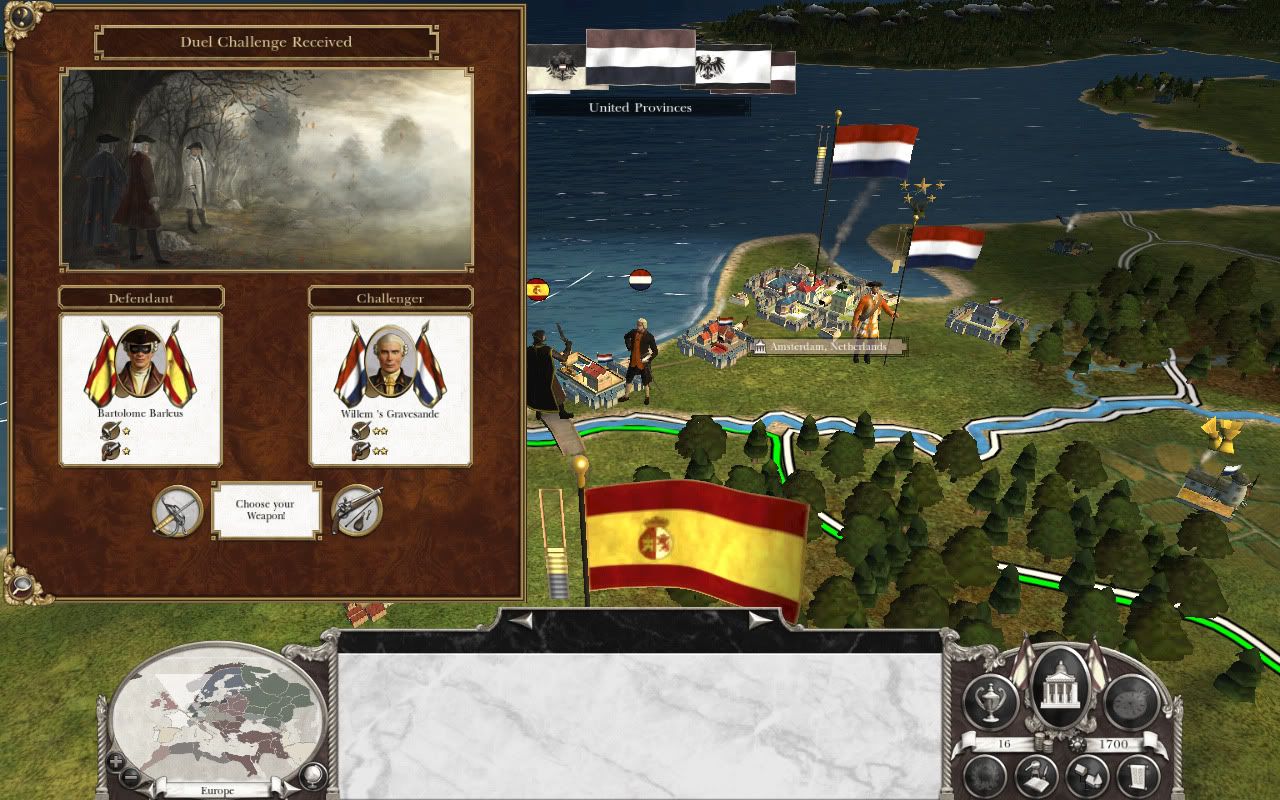
Before I can collect my tax income and proceed with restoring Spanish glory in the winter, the United Provinces offer me a chance to try out a duel. Apparently they're rather offended by that whole attempted espionage business and they send a gentleman to deal with this affront to their honor by challenging my rake to a duel. There's no option to flee, unfortunately, despite his supposed stealth skills, just a choice of weapon. I'm helpfully informed that the Dutch gentleman is better with both swords and pistols. I decide to go with swords, since that at least sounds less lethal.

Duel

I'm treated to a fancy video (seems a bit anachronistic, really) of the duel, which involves the two men chasing each other back and forth off the screen. Apparently they didn't have mobile cameras, at least. The last shot is of the gentleman running away with my rake waving his sword defiantly, and then a video of a carriage moving down a city street. I have no idea what the carriage was about since the duel took place in a wooded area, but against the odds my rake has won! That ought to show the Dutch. Maybe he'll be more confident in his sneaking next time.

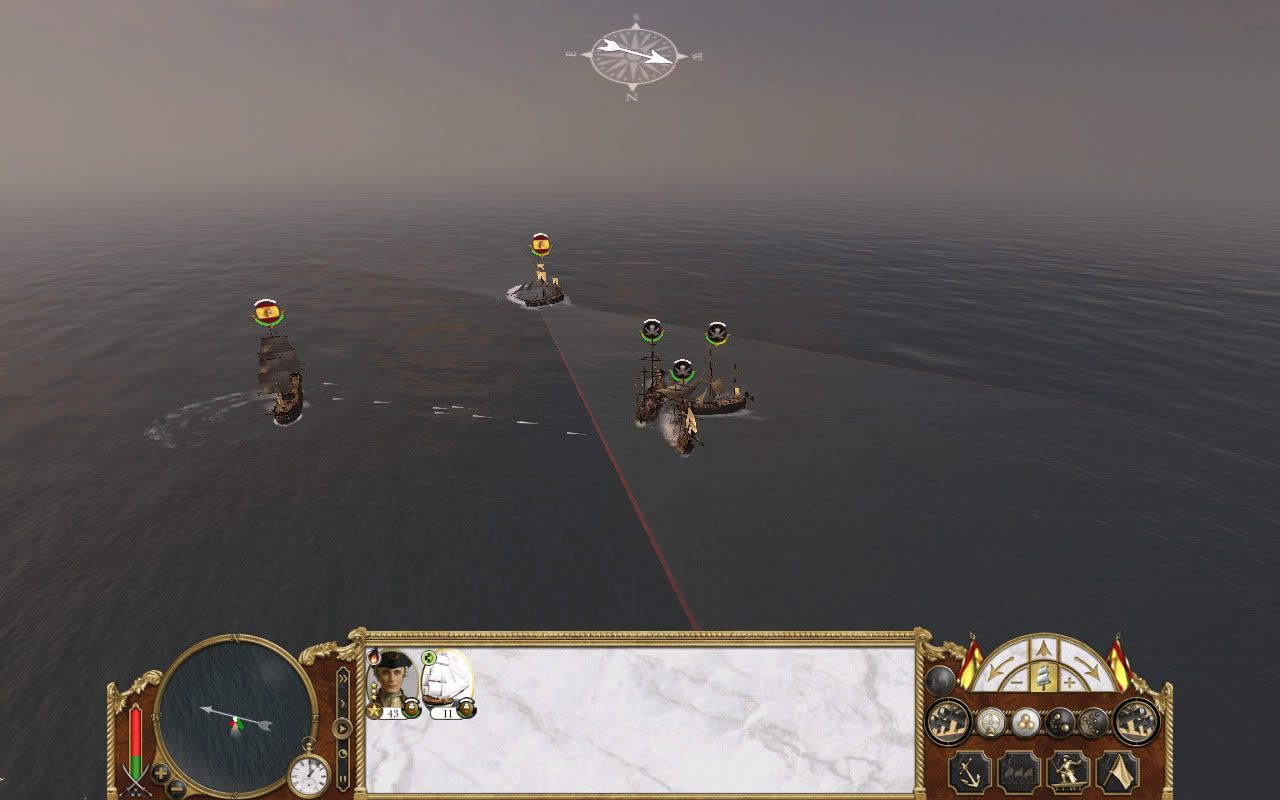
Before I can celebrate too much, however, there's another problem. Pirates have attacked by fleet in the Caribbean. And by fleet, I mean an admiral's flagship and one other ship, which is a bit less than I was expecting, but I suppose the Spanish Armada is in the past and Barbossa was an admiral with just two ships, right? This pirate's got more ships than I do, but no admiral, so I figure I've got a fighting chance and decide to duke it out. Not that fleeing from pirates was ever an option anyway, Spanish honor and all that.

Duel

It turns out the pirates may only have one more ship than me, but they have a lot more guns. For a while it looks like I might actually triumph, as I get the pirates grouped up and disable one of their ships, but things quickly fall apart after that minor victory, and soon both Spanish ships are fleeing from the battlefield. Err, battlesea? Anyway. Cowards. Shouldn't the British and French and Dutch be dealing with these guys? Or maybe New Spain?

Ah, yes. As winter rolls around, my adviser informs me that the government will occasionally assign me optional missions. Not sure who's assigning them, given that I seem to have control over everything, but in this case it's a moot point, as the mission is from New Spain. It seems a bit audacious for my own protectorate to be giving me orders. They want me to capture three territories (Texas, Curacao, and Trinidad) in exchange for giving up control to me. Shouldn't I already have control of them? This seems fishy, but they also have a lot of territory and I assume thus a lot of money. I guess it's something to work towards.

Next time: New allies, more pirates, and WAR!

I have a love-hate relationship with Civilization IV. I love the mechanics, the music, the dynamics, the customizability. I hate Isabella. Every time I played a game of Civ IV, without fail, sooner or later the Spanish came knocking. Every time, Isabella was pissed that I was a different religion than her, and sooner or later, without fail, she declared war on me. And every time I tried to negotiate with her, she just stared back haughtily at me. I have never hated a video game character so much--and all she is is an animated profile picture and some obscure game logic.

Somehow I find myself playing the Spanish in Empire: Total War.

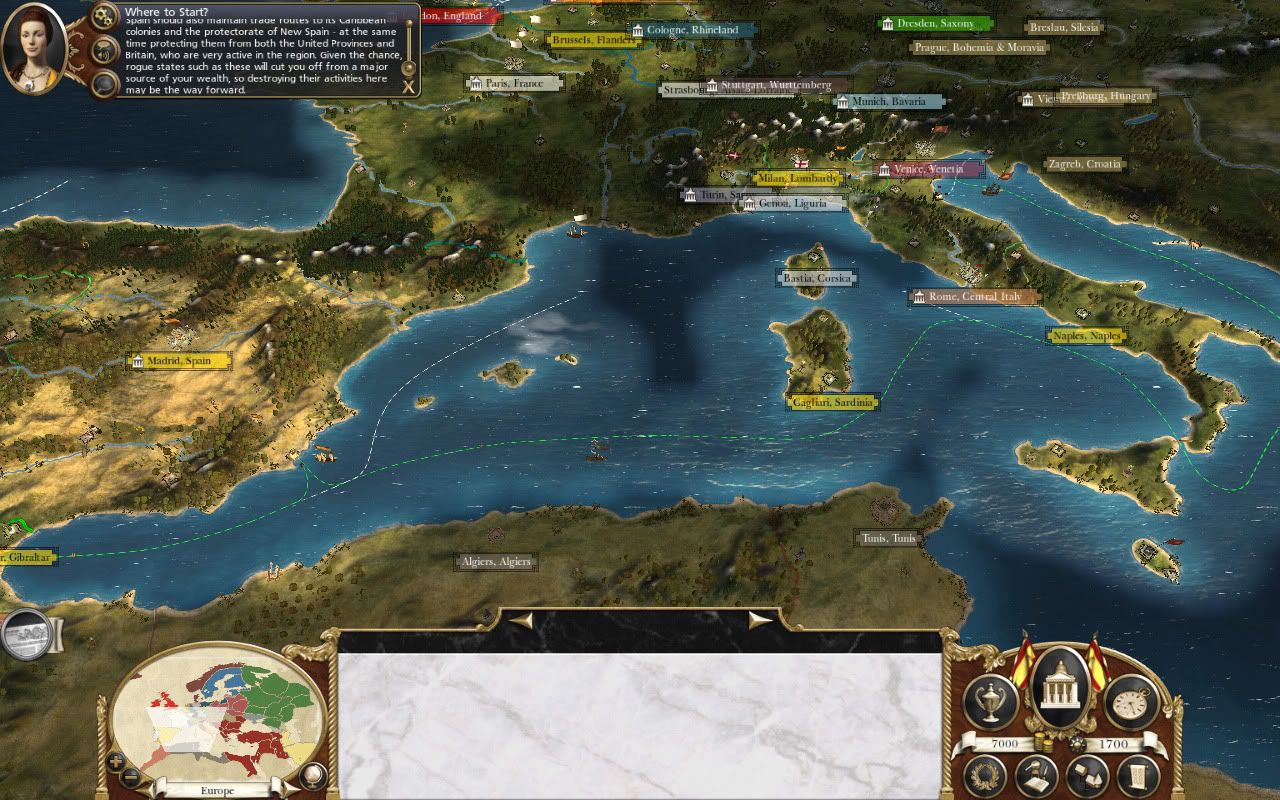
Europe

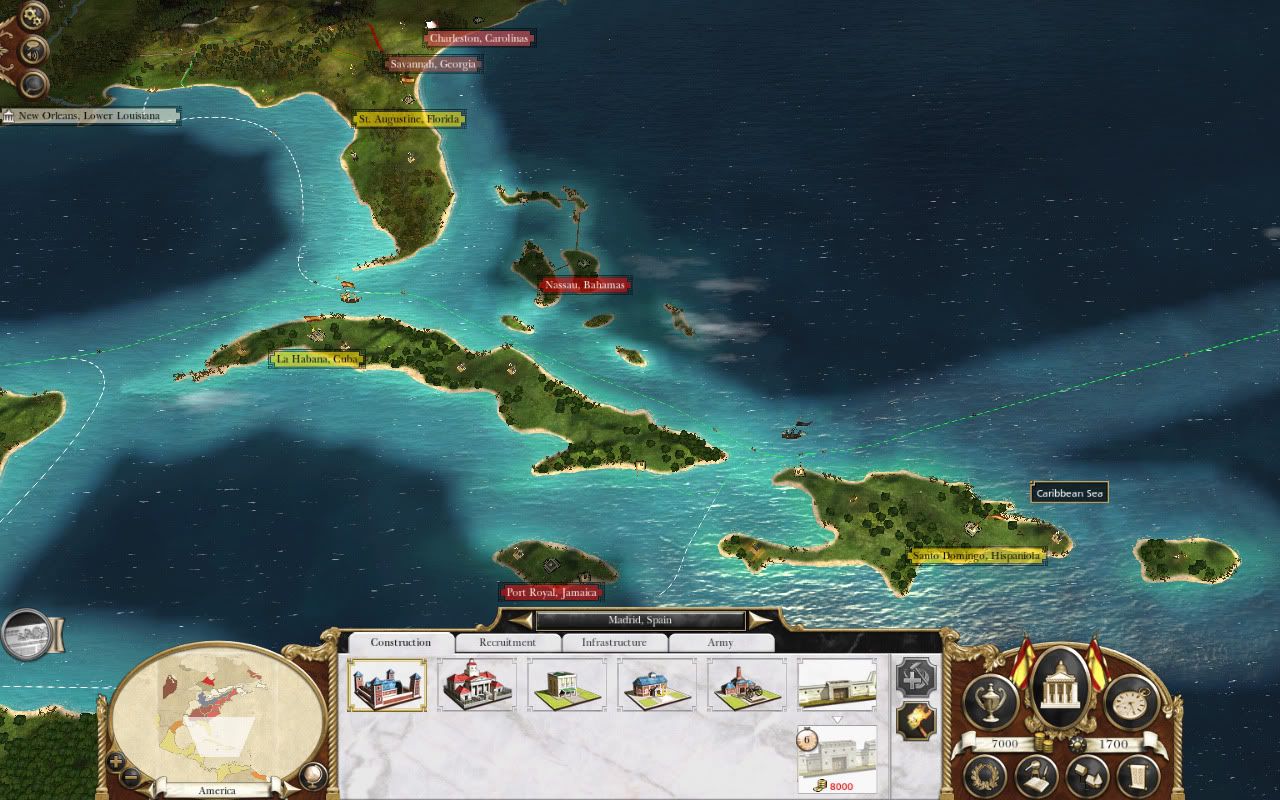
The year is 1700, and somebody's handed me control of what's left of the Spanish Empire. My history's a little hazy, but it's pretty obvious that the days of Spanish glory are in the past, though Spain does begin with control of various parts of Italy and southern Holland, which my adviser helpfully advises me is in danger of being overrun by the now Protestant republican northern Holland. She also gives me a quick overview of the Spanish possessions in the Americas, which seem surprisingly sparse until I realize that "New Spain" (all the land from California to Venezuela) is a separate faction set up as a "protectorate" but not under my direct control. Which seems a bit cheap, but they're still sending me lots of money and I'm not paying for upkeep, so I guess that works out.

America

My adviser warns that the "rogue states" of Great Britain and the United Provinces (northern Holland) may attempt to take my American possessions. Apparently "rogue state" still just means "people we don't like". The adviser also warns me not to piss off the French, but they're apparently my allies, which is nice since they're right next to me and I'm not looking forward to a protracted land war right now.

Also, apparently the last lion has died in Libya. Then the game gives me control.

I start off focusing on Flanders (southern Holland), per the advice. There's a nice army stationed there already, along with my best defensive general, which is nice, but there's no walls, so I order the construction of those. There's an option to build either a governor's mansion or a military governor's encampment--I'm going with the military governor. It looks like it lets me train better units. I've also got a "rake", e.g. a spy and assassin, which I decide to sent into Rotterdam, a mission that immediately fails. Oops. The rake gets away, at least.

I decide to send a missionary to Flanders as well to convert the Protestants and maybe improve my public image after that failed spy. Unfortunately it's going to take four years for him to get there by land and there's no ships on the northern coast to get him there faster. Ah, well. Maybe I should improve roads with next year's income.


America


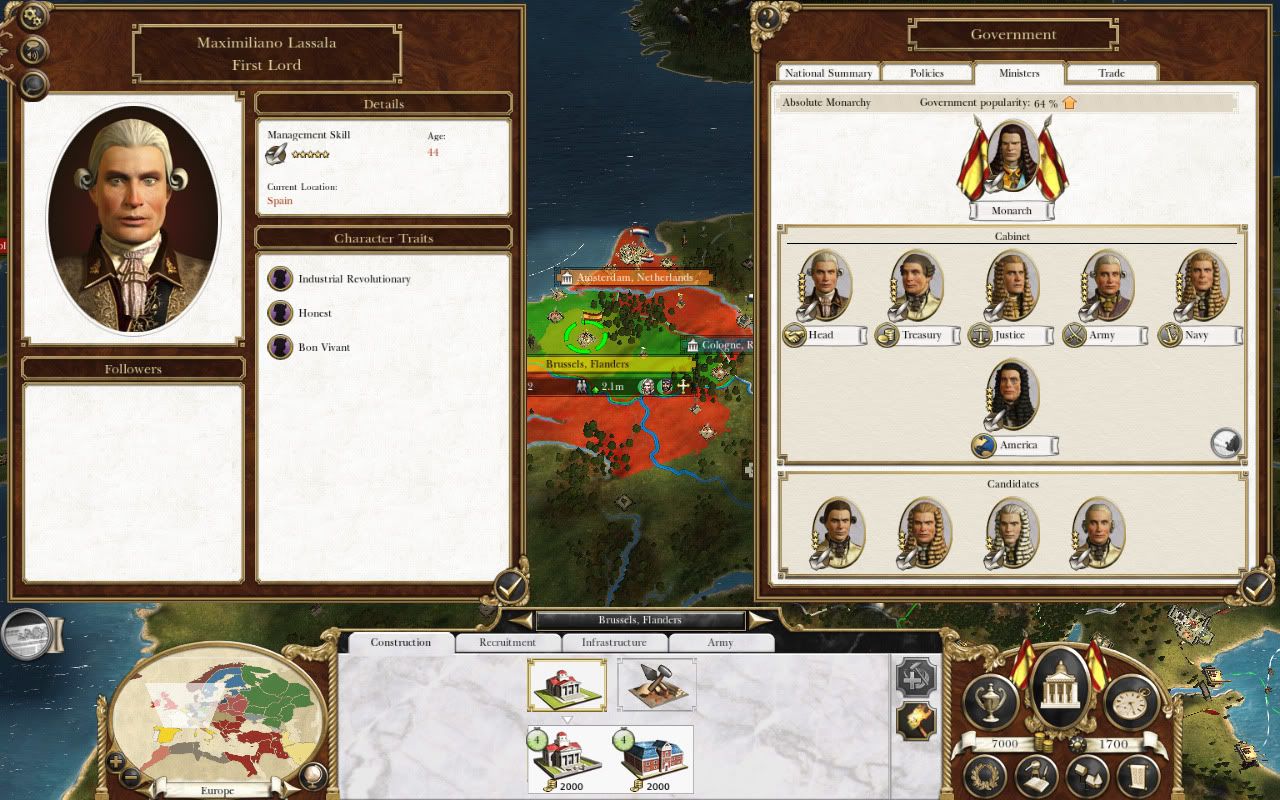
In addition to the regional options there's a lot of options for the central government, the most interesting of which are my ministers. My starting cabinet is full of floozies--apparently whoever was in charge before me didn't put much value in efficiency--but a few of the candidates are more impressive and some of the standing ministers perform better in other posts, so after some shuffling the government's looking much better. I'm hoping there are more monocled candidates soon, though.

The other significant option is technology research. There are options under military, agricultural, and more theoretical stuff. Initially I'm rather interested in the military technologies, of course, but after looking over them "Social Contract", surprisingly, grabs my eye, mainly because it increases technology research rate, which seems a good thing to get out of the way in the beginning. I also order one of my government-employed gentleman to a nearby college to speed up the research. The adviser informs me gentleman can also duel other characters, which seems too amusing not to try at some point.

Next time: pirates, a duel, and New Spain's impositions.

  • A movie about the end of the world that's not about saving the world but about who gets to live through it. Inspired by the 2012 trailers, which actually have a few interesting bits among the Roland Emmerich Epic Explosions, involving scenes of the government preparing what amounts to a modern Noah's Ark and deciding who gets on and who gets left behind. (Think also Battlestar's "Razor": "So you're going to decide just like that who lives and who dies?") You could even have lots of explosions and action shit with people revolting, trying to smuggle/attack their way onto the ark, etc., as well as a genuine Ethical Dilemma and angsty character drama (survivor's guilt, etc.).

  • A prose story (novel, novella, hypertext, whatever) about digital ghosts formed by the vast quantities of personal data left behind on the Internet in the modern world. Inspired by Caprica's pilot, except not with a stupid perfect copy but a fragmented, obviously artificial but still bearing significant resemblance construct, like a person with Alzheimer's, where sometimes they sound just like themselves and sometimes they're so very obviously not. Targeted straight at Uncanny Valley technological anxiety, identity theft fears, dreams of technological immortality via singularity and sci-fi's brains on disc trope, and more generally the piecemeal, constructed nature of modern cognizance (which has always been true obviously, just not so obvious, and the tearing away of the illusion of truth is what's so damaging and scary to us).

  • A video game about the exploration and terraforming of a new planet after Earth's downfall. Player character as the lone awakened human aboard an ark spaceship stocked with humans in hibernation/cryostasis/whatever and plant and animal specimens, sent down to a living planet's surface to scout. Encounters completely alien fauna and flora and early on involves lots of exploration porn, sweet vistas and crazy creatures and stuff, structured by a categorization mechanic ala Beyond Good and Evil or Pokemon Snap. Switches between on the planet (huge open world nonlinear exploration, with scout vehicle for fast travel around, all natural and curvy and colorful and alive) and the ark ship (cramped corridors, bulky square technological drab dead), getting orders from an AI terraforming protocol, gradually transitioning from exploration and cataloguing to terraforming, bringing in algae and small stuff at first and slowly escalating to higher terrestrial life forms, in the process wiping out the existing ecosystem. Watch all the cool creatures you hopefully became friendly with early on slowly killed off by your own efforts. Rebellion is inadvisable as the AI controls your fuel, food, water, etc. rations--and even if you just kill yourself, the AI awakens someone else to take over, and the game continues.

These are not the monsters exactly as I ran them; rather, they are updated versions based on my own experience with running them. They in general run on the more damaging side (as my players noticed) but also ideally of lower health and defenses, to get as close to L4D's greater swinginess (to use an RPG term) while still feeling like 4E. House rules that already do this (e.g. decreasing monster hit points and increasing their damage) will amplify this effect.

Zombie Horde Level 3 Brute
Huge Natural Humanoid (undead, swarm) XP 150
Initiative +1 Senses Perception +1; darkvision
Grabbing Mass aura 1; at the start its turn the zombie horde makes a melee basic attack against each enemy in the aura as a free action.
HP 55; Bloodied 27
AC 15; Fortitude 18, Reflex 15, Will 15
Immune disease, poison; Resist half damage from melee and ranged attacks, 10 necrotic; Vulnerable 5 close and area attacks, 5 radiant, 5 fire
Saving Throws +5 to effects imposed by ranged or melee attacks
Speed 6 squares, climb 4
M Slam (Standard; at-will)
Melee 1; +6 vs. AC; 2d6 + 3 damage.
m Grab (Standard; at-will)
Melee 1; +4 vs. Reflex; 1d10 + 3 damage, and the target is grabbed (until escape). Attempts to escape the zombie horde's grab take a -5 penalty.
m Engulf (against a grabbed target, standard; at-will)
Melee 1; +4 vs Fortitude; 2d6 + 3 damage, and the target is engulfed by the zombie horde (until escape). While engulfed the target is grabbed, restrained, takes ongoing 10 damage (ongoing 5 while the zombie horde is bloodied), and slides into an adjacent square occupied by the zombie horde. An attempt to escape being engulfed takes a -5 penalty (not cumulative with the zombie horde's Grab penalty). Any ranged or melee attack against the target instead targets the zombie horde. While engulfing a target, the zombie horde can take no action other than to sustain the engulfment, although its aura still functions.
Horde Stability
The zombie horde can reduce any push, pull, or slide effect against it by 1 square.
Thinning Out (when first bloodied)
The zombie horde's size changes to Large, and all its attacks take a -2 penalty to damage.
Stragglers (when reduced to 0 hit points)
Three zombie rotters appear in any unoccupied space formerly occupied by the zombie horde.
Alignment Unaligned Languages --
Str 16 (+4) Dex 11 (+1) Wis 11 (+1)
Con 15 (+3) Int 3 (-3) Cha 3 (-3)

The zombie horde owes much of its design to a similar homebrew monster on the EN World forums by a user whose name I unfortunately do not recall. It begins as a fairly normal swarm creature (though unusual in that it is a swarm of Medium creatures) with an unusual and powerful Engulf ability that unfortunately I never got to try out in actual combat. The Engulf ability is meant to simulate getting surrounded by the horde in L4D and is quite dangerous, although as a brute the attack is unlikely to hit.

One of the additions to most of these monsters from the versions I ran is a vulnerability to fire. When the tank attacked my players their first thought was to set it on fire; I had not originally included any rules for it, but I decided on the fly to give the tank vulnerability to fire (although not actually catch on fire from such damage, to my players' disappointment), which I then transferred over to the rest of the zombies as I went over them afterwards. Purely from a 4E stand point, the radiant vulnerability is completely servicable and adding fire gives them an additional weakness, but fire is such an iconic part of L4D that I didn't want to give it up.

Zombie Hunter Level 3 Lurker
Medium Natural Humanoid (undead) XP 150
Initiative +8 Senses Perception +8; darkvision
HP 37; Bloodied 18
AC 17; Fortitude 16, Reflex 18, Will 16
Immune disease, poison; Resist 10 necrotic; Vulnerable 5 radiant, 5 fire
Speed 8 squares, climb 6 (spider climb)
M Claw (Standard; at-will)
Melee 1; +8 vs. AC; 2d6 + 3 damage.
m Pounce (only usable as part of a charge; standard; at-will)
Melee 1; +6 vs. Reflex; 1d6 + 3 damage, ongoing 5 damage, and the target is grabbed and dazed (escape ends all) and knocked prone. Attempts to escape the zombie hunter's grab take a -5 penalty. The zombie hunter enters the target's space, is dazed, and any melee or ranged attack against the target instead targets the zombie hunter. If the zombie hunter leaves the target's space for any reason, the grab ends.
Leaper
As a move action or as part of a charge, the zombie hunter can jump up to its speed without making an Athletics check and gains a +4 bonus to defenses against opportunity attacks provoked by jumping.
Flaming Hunter
If the zombie hunter takes fire damage, its attacks on its next turn gain a +2 bonus to damage (including ongoing damage).
Alignment Unaligned Languages --
Skills Stealth +9, Acrobatics +9
Str 14 (+3) Dex 17 (+4) Wis 14 (+3)
Con 13 (+2) Int 4 (-2) Cha 3 (-3)

Hunters were especially interesting to design due to their Pounce attack. I borrowed from the horde's already established Engulf ability for an attack that did a lot of damage if sustained (though, like the actual L4D hunter, the initial damage is less than a simple claw swipe) but also made the hunter more vulnerable. (In one encounter, I had a horde attack a hunter pounced on a character due to its aura; I figured it fit the mindlessness of the Horde.)

Flaming Hunter is one of my favorite features of any monster I've ever designed. Part of it is that I like the idea of mixing advantages and dangers--hit the hunter with fire to do more damage to it, but also make it do more damage. And part of it is simply for the fact that flaming hunters are probably my favorite part of L4D, to the point that I giddily scream "Flaming hunter!" and intentionally set myself on fire when playing as one. (I suppose a few people might not actually know: hunters in L4D do significantly more damage when on fire. They also don't take ongoing damage from fire while pouncing someone, which makes setting yourself on fire extremely effective in most situations.)

Zombie Smoker Level 3 Controller
Medium Natural Humanoid (undead) XP 150
Initiative +4 Senses Perception +3; darkvision
HP 43; Bloodied 21
AC 17; Fortitude 16, Reflex 17, Will 16
Immune disease, poison; Resist 10 necrotic; Vulnerable 5 radiant, 5 fire
Speed 6 squares, climb 5
M Claw (Standard; at-will)
Melee 1; +8 vs AC; 1d6 + 3 damage.
r Tongue Grab (Standard; recharge 56)
Ranged 10; +7 vs Reflex; 2d6 + 3 damage, ongoing 5 (until escape, and the target is knocked prone, pulled 3, and grabbed (until escape). Attempts to escape the zombie smoker's grab take a -5 penalty.
Sustain Standard: the target is pulled 3 squares. The first time the zombie smoker sustains this power, the target is dazed (until escape). The second time the zombie smoker sustains this power, the target becomes unconscious (until the target takes damage from an attack). If the zombie smoker fails to sustain this power, the target automatically escapes at the end of the zombie smoker's turn. The zombie smoker can only recharge this power when it does not have a target grabbed.
c Smoking Cloud (when the zombie smoker is reduced to 0 hit points) ♦ poison
Close burst 1; +7 vs Fortitude; 1d6 + 3 poison damage, and the target is weakened and takes a -2 penalty to attack rolls until the end of its next turn.
Alignment Unaligned Languages --
Skills Stealth +9
Str 14 (+3) Dex 17 (+4) Wis 14 (+3)
Con 11 (+1) Int 5 (-2) Cha 3 (-3)

The smoker is my favorite of L4D's zombies, and it proved the most annoying of any of the zombies in the 4E version due to its ability to attack at range and quickly disappear. The smoker is labeled here as a Controller, but that's mostly for diversity: all of the specials are clearly Lurkers, with the boomer having an obvious Leader ability as well, but smokers clearly have a minor in controlling as well--their job, after all, is not so much damage as disruption of the survivors' formation.

While the smoker proved the most annoying of foes for my players, it never managed to sustain its grab long enough to reach the more powerful effects (it kept strangling the ranger, who had a very high Acrobatics modifier), so I'm not sure how those work out. Obviously it's very powerful for a level 3 monster, but I also ruled that players could use their own move action to make an escape check for the grabbed player (essentially L4D's melee-to-free), which I don't think is RAW an option but seems reasonable.

Zombie Boomer Level 2 Lurker (Leader)
Medium Natural Humanoid (undead) XP 125
Initiative +5 Senses Perception +1; darkvision
Boomer Stench aura 1; enemies in the aura take a -2 penalty to attack rolls.
HP 26; Bloodied 13
AC 15; Fortitude 13, Reflex 13, Will 14
Immune disease, poison; Resist 10 necrotic; Vulnerable 5 radiant, 5 force
Speed 5 squares
M Claw (Standard; at-will)
Melee 1; +7 vs. AC; 1d6 + 3 damage.
c Vomit (Standard; recharge 6) ♦ Acid
Close blast 3; +5 vs Reflex; 1d10 + 3 acid damage, and the target is blinded (save ends). While a target is blinded, zombies gain a +4 bonus to damage rolls against the target.
c Boomer Burst (when the zombie boomer is reduced to 0 hit points) ♦ Acid
Close burst 2; the zombie boomer makes a Vomit attack against each non-zombie creature in range.
Alignment Unaligned Languages --
Str 13 (+2) Dex 11 (+1) Wis 11 (+1)
Con 8 (+0) Int 3 (-3) Cha 3 (-3)

Boomers are a finicky beast. Due to the way hit points work they need to be of lower level (or have a general vulnerability, I suppose, or make them minions, which would be hilarious) than the other zombies to make them seem easier to kill. I also didn't get a chance to see how their signature vomit interacted with zombies in play; the boomer's only appearance in combat only hit one player and the only other zombie around, a horde, was blocked by the rest of the characters.

Zombie Tank Level 3 Elite Brute
Large Natural Humanoid (undead) XP 300
Initiative +1 Senses Perception +2; darkvision
HP 116; Bloodied 58
Regeneration 5
AC 17; Fortitude 19, Reflex 15, Will 16
Immune disease, poison; Resist 10 necrotic; Vulnerable fire, radiant; if the zombie tank takes fire or radiant damage, its regeneration does not function on its next turn.
Saving Throws +2
Speed 7 squares, climb 4
Action Points 1
M Slam (Standard; at-will)
Melee 1; +6 vs AC; 2d6 + 3 damage, and the target is pushed 3 squares and knocked prone.
m Smash (against a prone target; sandard; at-will)
Melee 1; +6 vs AC; 3d8 + 3 damage.
a Rock Throw (Standard; recharge 3456)
Area burst 1 within 10 squares; 1d6 + 3 damage, and the target is pushed 1 square and knocked prone.
Swat (when an enemy moves adjacent to the zombie tank; immediate reaction; at-will)
The zombie tank makes a melee basic attack against the triggering enemy.
Alignment Unaligned Languages --
Skills Athletics +9
Str 17 (+4) Dex 11 (+1) Wis 13 (+2)
Con 18 (+5) Int 3 (-3) Cha 3 (-3)

Ah, the tank. The players appropriately grew terrified when the tank arrived, although due to its lack of entourage it failed to live up to expectations. And while its Slam and Swat abilities proved accurately powerful, I never got a chance to use Smash, which would have a significant chance of knocking a level-appropriate character unconscious. Due to the interior setting I also never used Rock Throw, but only pansies use that anyway. Unfortunately I could figure out no way to included the tank's ability to kill everyone with one punted log, car, or forklift and stay balanced.

The Boys are Back in Town

My last campaign was a travelogue in structure; that is, the characters were on a journey (though their destination changed and at times they weren't exactly sure what it was) and thus rarely visited the same place twice. They had no "home base", in campaign structure terms: a town or other location which they visited after completing major quests.

One of the many things different with my summer campaign is that I am trying to establish something of a home base, or at least let the characters stay in one location longer. But for that to matter you have to have an established setting with meaning and context, which means more than a map with a key and some brief description. I meant to reestablish (or really, establish, given the loose context in which the campaign began) the setting of the town of Winterhaven upon the characters' return, but, well, if you read these postmortems you know I mean to do a lot of things. (In retrospect, forcing the players to walk back to Winterhaven from the ruins of the Keep, and thus through the farms that surround it and through the gates and such, would have given plenty of opportunities for just this sort of thing. Oops.)

Instead, the characters found themselves in the ancient stone tower at the center of the town, which had gone unremarked their previous visit. They briefly met the tower's occupant, an ancient sage named Valen who offered some brief comedy (by pushing one of the characters off the tower's roof and then casting Feather Fall just before he hit the ground), then met with Freddy Lipton, their nominal employer (of sorts) on the expedition to the Keep, who simply directed them to convert their loot into gold at the nearby store--whereupon they were arrested by Winterhaven's guard captain, Andre de Ker, who had previously stirred trouble with the characters.

Only as Good as the Villain

Andre de Ker is, I think, one of the successes so far of the summer campaign. Villains are always interesting characters to me, in that I don't truly believe in "evil", just in the effects that fear and self-righteousness can have on people. De Ker is the kind of villain I appreciate and I think players appreciate a lot as well: not a villain with grand schemes whose opponent is the world, something that players have a hard time getting involved in, but a villain personally to the characters, whose evil is as direct antagonism against the players.

As the players realized as they worked out de Ker's past as a failed adventurer (from comments by Valen and de Ker's strange obsession with the Keep), de Ker is not so much evil as pathetic and jealous of actual successful adventurers. Making the conflict personal made the players hate him, not just the characters (leading to some hilarious moments in session 5).

You are Number Six

Not so successful was the concurrent introduction of our new fifth player. Introducing new characters is an art I have little experience with (and never on the DMing end), and the circumstances were did not help the situation: I helped the player create her character in the hours before the session, and our only discussion of how she might fit into the ongoing campaign was during the brief car ride over to our playing location.

I do think that the character creation process itself was slightly better. Since I knew for some time we'd be adding a new player, I gave some thought as to how to introduce the concept of character creation in a less haphazard way than with the first four players of this campaign. I realized that power sources, often ignored by more experienced players, are actually a very good way of presenting choices to new players: since I imagine most people unfamiliar with RPG mechanics come into the game wanting to play a magic user, a weapon wielder, a divine caster, etc., the power sources are, it seems to me, a better place to start than with classes or races, of which there are of course many. And if they do have a grasp of basic RPG mechanics--enough to grasp the class rolls, at least--then you can easily narrow down the myriad choices. In this case the player liked the sound of the Primal classes and, since she had wanted a companion similar to our ranger's beast companion, a shaman became a natural choice.

The actual character's introduction was unfortunately more-or-less nonexistant. The characters met her as a fellow prisoner arrested by de Ker but I never actually prompted an appropriate introductory dialogue. Once the players were freed (due to a zombie attack and most of de Ker's guards being slain in the initial onslaught), they simply brought the shaman along with them, since she was now a member of the party, of course.

ZOMG

There was a period of time while designing the Keep that I had no idea what would come next. I pondered various possibilities and eventually returned to one of the basics: an undead attack. It flowed naturally from the established background of the Keep (though the players have yet to figure out the exact connection) and gave an opportunity to run a series of encounters I have personally wanted to do for some time: Left 4 Dead, D&D style. I actually experienced a L4D-inspired encounter in a campaign I play in (and thus all the credit goes to that DM for the idea), but for my own I created custom versions of all the L4D zombies (minus the witch, although the imagery of the witch did come into play).

I didn't get to use them all as planned, unfortunately: the series of three combat encounters, always lengthy in 4E, in the back half of a session meant combat fatigue set in and the climatic battle--set in the Clue manor, standing in for the home of Winterhaven's Lord Warden, and featuring a tank, a smoker (which previously ambushed the characters while they were outside), a hunter, a boomer, and a horde, I ended up cutting the final encounter down to a brief confrontation with a horde and a boomer (which simply ran when the horde fell) and one-on-five fight with the tank, who despite his elite status (and due to my forgetting his regeneration) fell quickly.

The cliffhanger--approaching the final accessible room on the first floor to hear crying--proved quite effective, though.

I chose my eyes and my hair and my face. I chose where I'm from and what I've done. I chose my name.

Despite its cinematic presentation (and what cinematic presentation it is!), Mass Effect is rooted in the Western RPG tradition (whether or not it actually is a Western RPG first and not a third-person action game with elements of western RPGs ala Deus Ex), which means players have a significant influence on how their character acts within the game--after all, the game was developed by Bioware, best known for Baldur's Gate, Neverwinter Nights, and Knights of the Old Republic, the epitome of Western RPG tradition. Mass Effect begins with a player choosing their name, physical appearance, and history. Before the opening cutscene finishes the player is already presented with their first choice: will they chastise a sarcastic crew member or listen to their concerns?

Those who have played Bioware's other games know the drill. The first two-thirds of Mass Effect play like a better, Star Wars-less version of Knights of the Old Republic. The plot is authored, and so are the menu of your character's responses, but you do have a menu of responses. You always have the choice: fight or negotiate. Kill or don't. Or, of course, don't do anything at all, for the myriad side quests. It may not be much of a choice, but combined with the custom appearance and custom "talents" (AKA skills, spells, whatever you level up when you level up in an RPG), most players come to feel a sense of authorship over their character, a sense that they are their character. That's (generally) the point of Western RPGs, in the way it is absolutely not in their Japanese counterparts.

At the conclusion of the introductory mission, the player's character is affected by an alien "beacon" and experiences a vision. A player only sees quick cuts of unintelligible images, but when approached by party members, the character starts talking about killer robots and mass extinction. It's a startling disconnect between player and character, but digestable: alright, so that's what it was, what now? But the disconnect doesn't go away; it grows. As the player continues through the game, the character expresses more and more certainty that the killer robots from the vision are the real threat, not the renegade special forces operative the character has been persuing, going so far as to demand action from the Council that rules most of the galaxy. The Council's response is predictable: you had a vision. We'll wait for a bit more evidence before starting a war.

The problem with this was that I thought the same thing. Following the "paragon" path (the "good" way, which also emphasizes cooperation), I wanted to agree with the Council, agree to look for further evidence first, agree to continue searching for the rogue operative. But the options presented to me were: demand the Council take action against the killer robot threat, or demand it nicely.

I'm a storyteller. I see the world in stories. That's not saying much, because this is true of everyone. What is a story, after all? It's an organization of reality, an illusionary order imposed by our brains to make sense of the fundamentally nonsensical universe. So why say I'm a storyteller? Because it means something else to most people, and the difference between that meaning and my meaning is what I want to talk about. For those with some knowledge of narrative theory this won't be anything new or interesting, except maybe the stuff about video games and D&D later.

When most people think "story", they think a book, or a movie, or whatever. Words, images, a sequence of events experienced by and actions taken by characters, fictional or non. For most people, a story is a distinct entity, separate from them, that they may borrow for a time but that remains outside of them. If a story is in a forest and no one's around to read it, is it still a story? Most people say yes. The answer is no.

Well, not necessarily, because "story" is just a word and it means whatever you want it to mean, whatever meaning you endow it with, but there are other words for that sort of thing. "Text", usually: if a text is in a forest and no one's around to read it, is it still a text? Yes. (Well, actually, I would say no, because I think that all that really exists is the relationships between things and that the idea of "things" is just another false order constructed by our brains to make sense of nonsense, and so something without any relation to anything else doesn't exist, but that's for another time.) Unless you mean something else. But using a different word isn't the problem; the problem is that people don't accept that anything exists besides text. That, whatever you want to call it, there is something more than text.

Over lunch today I had an odd thought. I was considering what kind of people play D&D, and this is the list I came up with: the people who are interested in the math and statistics (call them the mathematicians), are the people who are interested in the social aspect (socializers), the people who enjoy the experience of the world and narrative (narrativists), and the people who can only think well of themselves when they're pretending to be a Level 50 Badass Motherfucker of Doom (the creepy fucks who get off on hitting on female NPCs and fucking with other PCs).

And then I realized that these on-the-spot categories map rather well to the four MMO player type model of Achievers (the mathematicians, who want to maximize their stats), Socializers (duh), Explorers (the narrativists, who want to experience the world), and Griefers (who want to dominate other players). Maybe I was just unconsciously influenced by my knowledge of the model, and the model itself is not particularly concrete, and my own player type list certainly holds little weight, but it's interesting nonetheless. I sort of wonder if these four player types rather correspond to generic types of people in general? Achievers are the businessmen interested in accomplishment for itself, Socializers are people people, Explorers are individualists, artists, creators, and Griefers are the jerks. Hmm.

Minerva is a Half-Life 2 single-player mod, which immediately makes it notable simply because there aren't many of those. And its being good as well puts it practically in a category unto itself.

After at least a year (I don't remember when the last chapter was released exactly) the final two chapters (for a total of four) were released about a week ago. Having loved the first two -- I thought they were in many ways an experience superior to that of the actual Half-Life 2 -- I eagerly anticipated more great level design, pretentiously enigmatic Marathon-esque narration, haunting music, and so on.

I was disappointed. (Spoilers in this review . . . as always.)

Over the past three days, I have, along with a group of between ten and fifteen other people, rewatched the entire first season of Heroes. A good show, especially for network television. One of the things I was struck by while rewatching is its thematic coherence, something I'm fairly certain is quite rare for television in general: from the beginning, the message of love through togetherness and the need to unite to overcome is clearly emphasized without hitting you over the head with it, dealt with in a number of different ways without it getting monotonous. The themes themselves are not particularly original (indeed, are glaringly unoriginal), but my point is that they're presented well.

Replaying Deus Ex (in shoot-'em-up form rather than my traditional pacifistic inclinations) and reminded of its brilliance in not just the big things but little things as well:

  • A bum in Battery Park, New York City singing "My Country Tis of Thee". The "sweet land of liberty" line is of course particularly poignant given the circumstances of the game. His off-tune voice and genuine enthusiasm (he seems to really believe what he is singing, not just reciting it) lend it an earnestness that make it all the more sad when considering how his faith in his country has been abused (both in the game and in reality).

  • A boy in the Mole People's tunnels who proudly proclaims that when he grows up, he will "know everything". The boy seems to see this as the ultimate accomplishment, suggesting that when he does so he will be above or on top of everyone else. A subtle reference (you don't have to talk to him, and he's easy to miss) on the "Knowledge is power" motif that dominates the game (it is, after all, MJ12's motto, in the Latin I used in the title of this post).

  • Another boy int he Mole People's tunnels terrified of some secret demon he describes as "the man with red eyes". At first glance nothing more than an amusing inclusion referencing the devil -- except that (presumably due to his augmentation) Bob Page's (the ultimate villain of the game) eyes are red. You can actually see this early in the game, too, in the magazine in the UNATCO lounge.
I love such little touches. They're especially rare in video games but even in more mature mediums subtlety and the presence of larger themes even in minute details is an art that is seldom done well (when attempted at all). Of course, I could write pages and pages on Deus Ex -- the Mole People (or more precisely, the subway station directly before meeting them) are a particular favorite of mine, as are the characters of Gunther Hermann and Joseph Manderley.

For future reference, both a fascinating dialogue and proof that video games are more than just entertainment (this is from Deus Ex):

MORPHEUS: JC Denton. 23 years old. No residence. No ancestors. No employer. No --

JC DENTON: How do you know who I am?

MORPHEUS: I must greet each visitor with a complete summary of his file. I am a prototype for a much larger system.

JC DENTON: What else do you know about me?

MORPHEUS: Everything that can be known.

JC DENTON: Go on. Do you have proof about my ancestors?

MORPHEUS: You are a planned organism, the offspring of knowledge and imagination rather than of individuals.

JC DENTON: I'm engineered. So what? My brother and I suspected as much while we were growing up.

MORPHEUS: You are carefully watched by many people. The unplanned organism is a question asked by Nature and answered by death. You are another kind of question with another kind of answer.

JC DENTON: Are you programmed to invent riddles?

MORPHEUS: I am a prototype for a much larger system. The heuristics language developed by Dr. Everett allows me to convey the highest and most succinct tier of any pyramidal construct of knowledge.

JC DENTON: How about a report on yourself?

MORPHEUS: I was a prototype for Echelon IV. My instructions are to amuse visitors with information about themselves.

JC DENTON: I don't see anything amusing about spying on people.

MORPHEUS: Human beings feel pleasure when they are watched. I have recorded their smiles as I tell them who they are.

JC DENTON: Some people just don't understand the dangers of indiscriminate surveillance.

MORPHEUS: The need to be observed and understood was once satisfied by God. Now we can implement the same functionality with data-mining algorithms.

JC DENTON: Electronic surveillance hardly inspired reverence. Perhaps fear and obedience, but not reverence.

MORPHEUS: God and the gods were apparitions of observation, judgment, and punishment. Other sentiments toward them were secondary.

JC DENTON: No one will ever worship a software entity peering at them through a camera.

MORPHEUS: The human organism always worships. First it was the gods, then it was fame (the observation and judgment of others), next it will be the self-aware systems you have built to realize truly omnipresent observation and judgment.

JC DENTON: You underestimate humankind's love of freedom.

MORPHEUS: The individual desires judgment. Without that desire, the cohesion of groups is impossible, and so is civilization.

MORPHEUS: The human being created civilization not because of a willingness but because of a need to be assimilated into higher orders of structure and meaning. God was a dream of good government. You will soon have your God, and you will make it with your own hands.

Some time ago I revisited a video game entitled Rome: Total War. Rome is, like its predecessors, a hybrid strategy game that combines high-level turn-based strategic planning with low-level real-time tactical battles. In terms of its gameplay, it's one of the most complicated and enjoyable video games ever made; one of the best the strategy genre as ever produced, at least. (In terms of everything else -- well, it really has nothing else. No plot, no interesting artistic direction, etc.)